 LittleLearners
🔢 Early Maths
Telling the Time: O'Clock (When and How Children Learn It)
The short answer
O'clock means the minute hand points straight up at 12 and the hour hand points at the hour number — so 3 o'clock is the short hand on 3 and the long hand on 12. In the UK, most children learn o'clock and half past during Year 1 (ages 5-6), starting with whole hours.
The two hands, simply explained
Every analogue clock has the same two hands, and mixing them up is the single biggest source of confusion. Teach the difference first, before any times at all. The short, thick hand is the hour hand: it moves slowly and points at the hour number. The long, thin hand is the minute hand: it moves faster and points at the minutes.
At o'clock, the minute hand always points straight up at 12. Whatever the hour hand points at, that is the time — no exceptions at this stage. Say the rule out loud together a few times: long hand on 12, read the short hand. Children who can recite that rule rarely misread o'clock times.
- Hour hand: short and thick, points at the hour number (call it the lazy hand — it barely moves).
- Minute hand: long and thin, points at the minutes (at o'clock it is always on 12).
- The numbers run 1 to 12 all the way round the face.
When UK children learn to tell the time
The English national curriculum introduces time gradually, and it is worth knowing the order so you do not jump ahead too fast. In Reception, children sequence the day — morning, afternoon, bedtime — and compare faster and slower. There is no clock reading yet, just the idea that time passes.
In Year 1 (ages 5-6), children learn to tell the time to the hour and half past the hour, and to draw the hands on a clock face to show these times. This is the o'clock stage. In Year 2 (ages 6-7), quarter past and quarter to arrive, followed by telling the time to five minutes.
- Reception: time language and sequencing the day — no clock reading.
- Year 1: o'clock and half past, reading and drawing the hands.
- Year 2: quarter past, quarter to, then five-minute intervals.
How schools teach o'clock
Most Year 1 classrooms follow the same gentle order. Copying it at home keeps your child in step with school, and each step is small enough to master in a few short sessions.
- Meet the clock: name the parts — face, numbers 1 to 12, hour hand, minute hand. Let them turn the hands on a big teaching clock.
- O'clock only: keep the minute hand on 12 and move the hour hand. Read together — 3 o'clock, 4 o'clock — until it is automatic.
- Draw the hands: give the time in words and let them draw both hands. Drawing is harder than reading, and it is the real test.
- Half past: the minute hand points straight down at 6, and the hour hand sits halfway between two numbers. Name that halfway position explicitly — it is the tricky bit.
- Mix and sort: o'clock and half past mixed together, so they must check the minute hand first and decide.
Practising at home
Ten minutes here and there beats one long weekly session, and time is the easiest topic to weave into the day because clocks are everywhere. Narrate the day in o'clock times: it is 8 o'clock, breakfast time — look, long hand on 12, short hand on 8. Ask what time bedtime is and let them find 7 o'clock on any clock in the house.
Play set the clock: you say a time, they move the hands on a toy clock or draw them. And try spot the mistake: set a clock wrongly and let them catch it — children love being the teacher. One more rule of thumb: analogue first, digital later. A digital display is read, not understood; the analogue face is what teaches how time actually works.
- Narrate real times through the day in o'clock language.
- Let them find familiar times (breakfast, bedtime) on any clock.
- Play set the clock with a toy clock or drawings.
- Set a clock wrong on purpose and let them correct you.
- Keep sessions to about ten minutes and stop while it is still fun.
Common mix-ups, and quick fixes
Three errors cover almost every mistake at this stage, and each has a simple fix. If your child reads the minute hand as the hour — it's 12 o'clock when the clock shows 3 o'clock — go back to the rule: long hand on 12, read the short hand.
- Reading the wrong hand: repeat long hand on 12, read the short hand until it sticks.
- Half past confusion: the hour hand sits between two numbers, so half past 3 looks close to 4. Teach it as halfway past 3, not quite 4 yet.
- Writing the time wrong: do not worry — accurate reading comes well before accurate writing at this stage.
What comes after o'clock
Once o'clock is solid, the natural order is half past, then quarter past and quarter to in Year 2, then five-minute intervals. Every step reuses the same two-hand logic, so a strong o'clock foundation pays off all the way up. Do not rush to quarters: a child who is rock-solid on o'clock and half past learns quarter past in days, while a child pushed too early often muddles all three for months.
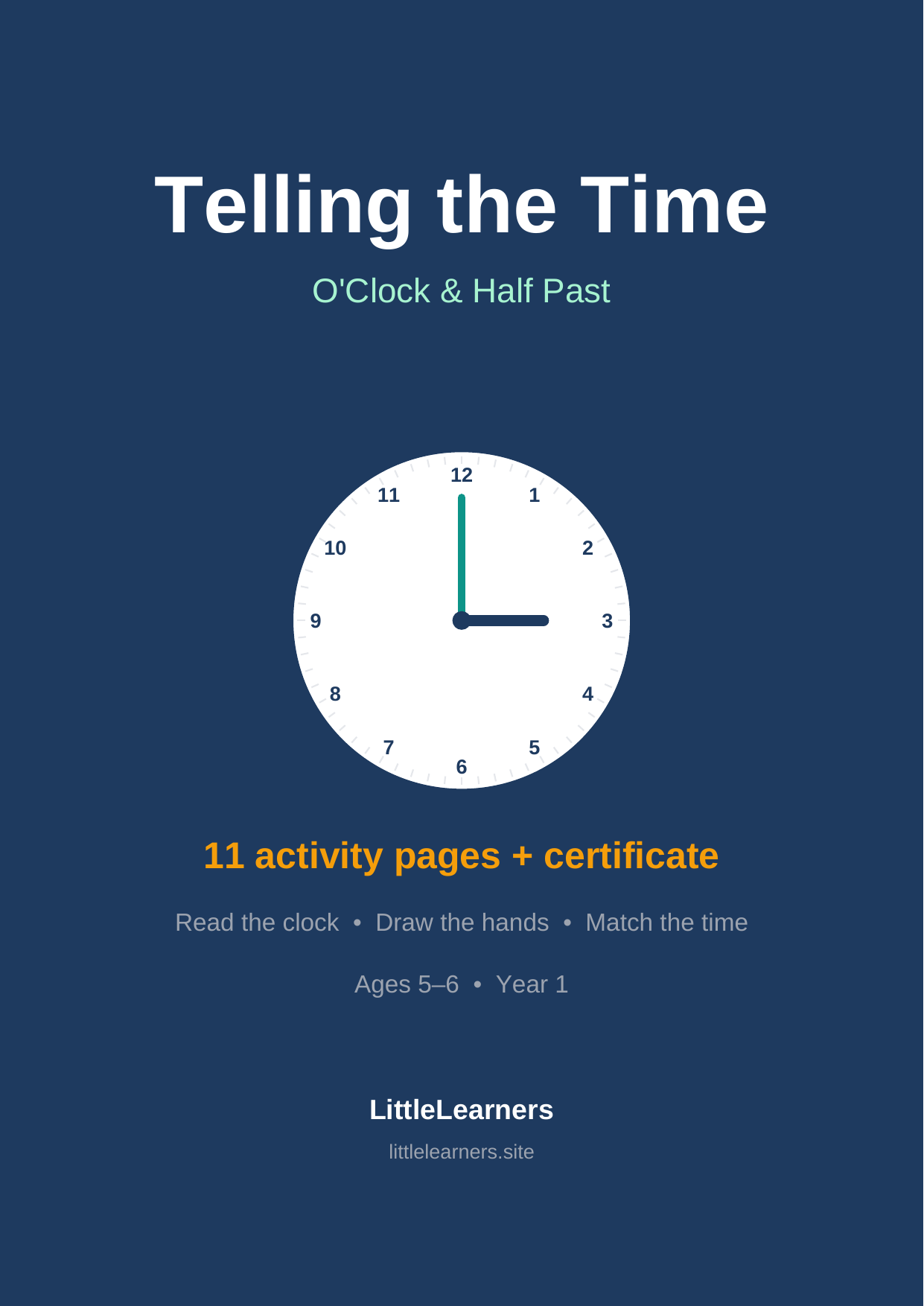
If your child is ready for structured practice, the Telling the Time Pack below follows exactly the school order in this guide — meet the clock, read o'clock, draw o'clock, then the same for half past — with matching games and a Time Star certificate at the end.
Practise this at home
Telling the Time Pack
12-page printable pack · FREE · Free forever. Download, print, enjoy — no sign-up, no payment.
Get the packParents also read
Number Formation 1-20: EYFS Guide
Number formation the UK-school way: the 0-9 rhymes teachers use, pencil grip stages by age, why reversals are normal, and how 11-20 build on 0-9.
Simple Addition for Ages 4–6
How to teach simple addition to 4–6 year olds the way UK schools do: concrete objects, then pictures, then written sums — with practical examples.
Shapes & Colours: What Reception Expects
What Reception actually expects your child to know about shapes and colours — 2D shapes, colour names and the honest truth about what's 'behind'.
Counting to 10: Fun Activities That Work
How to teach counting to 10: one-to-one correspondence, cardinality and subitising explained simply, plus counting games that work at home.
Number Bonds to 5 (and Why They Matter)
Number bonds to 5 explained for parents: what they are, why 5 comes before 10, five-frame activities and games that make the pairs stick.
Phase 2 Phonics Sounds in Order
Phase 2 sounds in teaching order — all five sets with pure-sound pronunciation tips, first blending words and a 5-minute daily routine.
Free printable packs for this topic
Questions parents ask
At what age should a child learn o'clock?
Most UK children learn o'clock in Year 1, around ages 5-6. Before that, time language such as morning, bedtime and in five minutes is the right focus.
Should I teach digital or analogue clocks first?
Analogue first. The clock face shows how time works — the hands moving round — while a digital display only shows digits to be read.
My child keeps mixing up the two hands. What helps?
Name them every single time: short thick hand means hour, long thin hand means minutes. The rhyme long hand on 12, read the short hand fixes most o'clock errors within a few days.
Is half past harder than o'clock?
Yes, because the hour hand sits between two numbers. Teach it as halfway past the hour, practise it separately, and only mix the two once o'clock is automatic.
How long does it take to learn o'clock?
With a few minutes of daily practice, most Year 1 children read o'clock confidently within a couple of weeks. Do not move on to quarters until it is automatic.
Do I need a special teaching clock?
A cheap toy clock with moving hands helps a lot for the set the clock game, but any wall clock in the house works for spotting and reading practice.