 LittleLearners
🔢 Early Maths
Shapes & Colours: What Reception Expects
The short answer
By the end of Reception, most children name basic 2D shapes (circle, square, triangle, rectangle) and common colours confidently, and start describing shapes by their properties — sides and corners. You don't need to drill: shape hunts, building play and colouring build this naturally through everyday talk.
What the EYFS actually says
Here's the honest version: the EYFS framework doesn't demand that your child recites shape names on command. It talks about children exploring the characteristics of shapes — noticing that a wheel rolls because it's round, that a box stacks because it's flat-sided.
In practice, Reception classrooms do teach shape names and properties through play, and by the end of the year most children confidently name circles, squares, triangles and rectangles. The framework's language is deliberately play-based; the classroom reality includes both play and direct teaching. Both matter.
The shapes worth knowing by the end of Reception
Focus on four 2D shapes first — these are the Reception core:
- Circle — no sides, no corners; rolls
- Square — 4 equal sides, 4 corners
- Triangle — 3 sides, 3 corners
- Rectangle — 4 sides, 4 corners (2 long, 2 short)
Beyond the basics: what comes next
Pentagons and hexagons enter formally in Year 1, but there's no harm in naming them during play — children love a impressive word like 'hexagon'. For 3D shapes, Reception is about handling and describing: cubes stack, spheres roll, cylinders do both. Formal 3D names (cube, cuboid, sphere, cylinder, cone) are taught in Key Stage 1.
Don't drill 3D vocabulary at four. Do let them build with boxes, roll balls down ramps, and hear you use the words naturally: 'pass me the cylinder block, please.'
A lovely bridge between 2D and 3D: press 3D objects into playdough and look at the 2D prints they leave — a cylinder makes circles, a cube makes squares. It's a small moment of genuine geometry, and children find it genuinely magical.
And when you're out and about, play 'shape spy': who can spot the most circles between home and the park? Mundane journeys become geometry hunts, and children start seeing shapes everywhere — which is exactly the point.
Colours: more than just naming them
Most three-year-olds name the main colours; by Reception the learning deepens. Talk about shades (light blue, dark green), mix paint and predict what happens, and use colour precisely: 'the crimson leaf' rather than just 'the red one'.
Colour mixing is secretly science: red + yellow makes orange is a prediction, an experiment and a result. Do it with paint, playdough or even bath colours and narrate what's happening.
There's a language payoff too. Colour words are among the first adjectives children master, and precise colour talk — 'the pale yellow one, not the bright yellow one' — builds the descriptive vocabulary that later powers both storytelling and science observations. When your child can describe exactly which leaf they mean, they're practising classification.
Talking about properties, not just names
The leap Reception teachers look for is from naming to describing. 'It's a triangle' becomes 'it has three straight sides and three corners.' This property language is what Year 1 geometry builds on.
Build it into everyday talk: 'Can you find something with four corners?' 'Is the plate curved or straight-sided?' 'Why does the ball roll but the book doesn't?' You're teaching mathematical reasoning disguised as chat.
Everyday ways to practise (no worksheets needed)
Shape learning lives in the real world better than on paper — and it quietly introduces two big mathematical ideas along the way: sorting and patterning. When your child sorts buttons by colour, then re-sorts the same buttons by shape, they're learning that objects have multiple attributes — a genuinely sophisticated idea.
Patterns come next: red-blue-red-blue with beads or blocks. Copying a pattern, then continuing it, then inventing one. Offer the materials and let them lead — coloured blocks, beads, buttons, even different pasta shapes. Ask 'what comes next?' when they build a pattern, and 'how else could we sort these?' when they tidy. You're building a mathematician one game at a time.
Here are the classics:
- Shape hunts: 'find three circles in this room' — windows, clocks, plates are everywhere
- Food shapes: sandwiches cut into triangles, round crackers, square cheese
- Building: blocks, boxes and recycled packaging — which shapes stack? which roll?
- Sorting: the cutlery drawer, the button tin, the toy box by shape or colour
- Walks: signs (triangles!), windows (rectangles), wheels (circles) — the street is a geometry lesson
- Pattern chains: threaded beads or Lego in repeating colour patterns — copy it, continue it, invent your own
When colouring counts as learning
Colouring gets dismissed as 'just' keeping children busy, but it does quiet work: pencil control for writing, colour vocabulary, staying inside boundaries (which is really hand-eye coordination), and — when you talk about it — descriptive language.
Make it richer with commentary rather than correction: 'you've chosen a lovely deep blue for the sea' beats 'stay in the lines'. Ask about choices: 'why is the sun purple today?' The answers are often wonderful.
You can also sneak in the property language from earlier: 'you've coloured all the triangles yellow and the squares blue — clever sorting!' Colouring becomes a place to rehearse shape vocabulary without it feeling like a quiz.
Keep it playful, keep it everywhere
Nobody ever learned shapes from being quizzed at the dinner table. They learned them from a parent who said 'ooh, look — the moon is a circle tonight' often enough that it stuck.
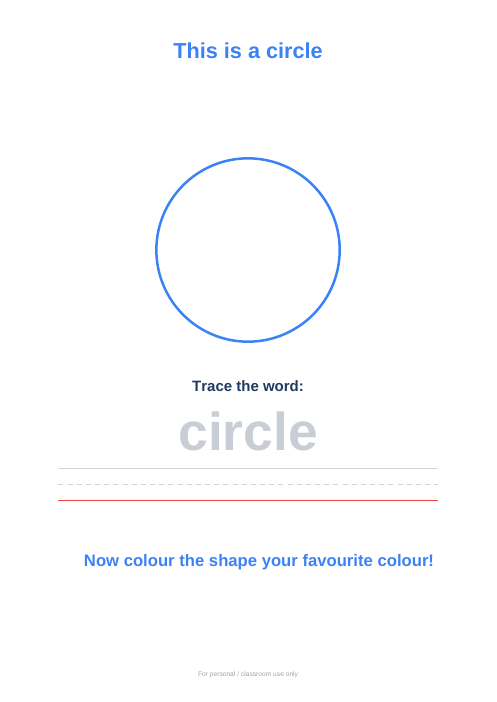
If you'd like printable pages to back up the real-world play — traceable shape names, big bold shapes to colour, and the vocabulary Reception uses — our shapes and colours pack gives you seven pages to print whenever a rainy afternoon needs one.
Practise this at home
Shapes & Colours
7-page printable pack · £3.99 · Buy once. Yours forever. No subscription, no renewals.
Get the packParents also read
Number Formation 1-20: EYFS Guide
Number formation the UK-school way: the 0-9 rhymes teachers use, pencil grip stages by age, why reversals are normal, and how 11-20 build on 0-9.
Simple Addition for Ages 4–6
How to teach simple addition to 4–6 year olds the way UK schools do: concrete objects, then pictures, then written sums — with practical examples.
Counting to 10: Fun Activities That Work
How to teach counting to 10: one-to-one correspondence, cardinality and subitising explained simply, plus counting games that work at home.
Questions parents ask
Should my 4-year-old know all the shapes?
Naming circle, square, triangle and rectangle by the end of Reception is typical. Describing them by sides and corners is the Year 1 step. Don't worry about pentagon or hexagon in Reception — they're a bonus, not a benchmark.
What about 3D shapes — should we practise those?
Handle them, don't drill them. Building with boxes, rolling balls and stacking cups teaches more about 3D shapes than any flashcard. The formal names come in Key Stage 1.
My child calls every four-sided shape a square — is that a problem?
Not at all — it's a normal developmental stage. Squares are the prototype rectangle in young minds. Keep modelling 'that's a rectangle — like a stretched square' and the distinction arrives on its own.
When do children learn shapes like hexagon?
Hexagons and pentagons are formally taught in Year 1. Many Reception children pick the words up through play earlier, which is lovely but not expected.
Is colouring 'real learning' or just keeping them busy?
Both. It builds the hand control writing needs, practises colour vocabulary, and develops concentration. It's not a substitute for maths talk, but as part of a playful mix it's genuinely valuable.
I think my child might be colour-blind — will school notice?
Schools do screen for it, and teachers notice quickly when a child consistently mixes certain colours. Mention it to the teacher if there's family history — it's common (especially in boys), easily managed, and nothing to worry about.