 LittleLearners
🔢 Early Maths
Counting to 10: Fun Activities That Work
The short answer
Counting to 10 means more than reciting numbers: your child needs one-to-one correspondence (one number per object), cardinality (the last number tells how many), and the number words in stable order. Practise by counting real things slowly — stairs, snacks, toys — touching each one, and always finishing with 'so that's five altogether.'
Counting is actually five skills, not one
When a child rattles off 'one-two-three-four-five', parents naturally celebrate — and it is worth celebrating. But reciting the number words in order is only one part of counting. Teachers talk about five principles children have to put together, and knowing them helps you spot exactly where your child is stuck.
In plain parent language, the five are: saying the number words in the right order; giving one number word to each object (and only one); understanding that the last number you say tells you how many there are; knowing you can count anything — sounds, jumps, ideas; and knowing it doesn't matter which object you start with.
You don't need to memorise this list. You just need to know that 'can't count yet' usually means one specific piece is missing — and each section below tells you how to practise that piece.
One-to-one correspondence: one number, one object
This is the piece most young counters get wrong: they say numbers faster than they point, or point twice at the same teddy. One-to-one correspondence means each object gets exactly one number word, said as it is touched.
Slow it down. Ask your child to touch — or better, move — each object as they count it: slide each pasta piece into a bowl, drop each conker into a bucket, tap each stair. Moving beats pointing, because it stops double-counting.
Line objects up in a row to start with; a scattered pile is much harder. When they can count a neat row of ten without rushing, scatter them and try again.
- Slide-and-count: move beads, pasta or buttons one at a time into a container
- Stair counting: one number per step, going up and down
- Touch-and-say: tap each picture in a book as you count
- Put one biscuit on each plate — counting with a purpose
Cardinality: the last number is the answer
Here is the moment that turns reciting into real maths: after counting five ducks — 'one, two, three, four, five' — the child understands that 'five' means how many ducks there are. This is cardinality, and it doesn't arrive automatically.
You'll know it's missing when you ask 'how many?' and your child starts counting all over again, or just repeats the last word without meaning it. The fix is modelling: every time you count together, finish with the magic phrase — 'one, two, three, four — so that's four altogether.'
Then hand the question back: 'You count, then tell me — how many altogether?' The word 'altogether' is doing real teaching work here. Use it constantly.
Subitising: recognising small numbers at a glance
Subitising (a word teachers love) just means seeing how many without counting: you look at two apples and instantly know 'two'. Adults subitise up to about five; children build it through games.
Dice are the classic tool — roll, and ask 'how many?' before they start pointing. Dominoes, fingers held up quickly, and plates with a few biscuits all work. Start with 1–3, then stretch to 4 and 5.
Why bother? Subitising is the foundation of number bonds later: a child who sees 'four' as a pattern (not four separate ones) finds it much easier to learn that 4 and 1 make 5. It's also genuinely fun — quick-fire games feel like play, not lessons.
Counting games that actually work
The best counting practice doesn't look like practice. It happens in the gaps of the day, with things your child already cares about:
- Hide and seek: the seeker counts to 10 (or 20) — real motivation to get the order right
- Snack maths: 'Can you get me five raisins? Now eat two — how many left?'
- Number hunts: hide number cards 1–10 around the room; find them and put them in order
- Clap, stamp, jump: count actions instead of objects — ten star jumps is very memorable
- Setting the table: one fork per person, counting as you go
- Parking toy cars: numbered bays 1–10, drive each car to its number
- Keep sessions to five minutes. Ten happy counts beat thirty forced ones.
Mistakes that are completely normal
Skipped numbers ('one, two, five, nine…'), numbers in a jumbled order, counting the same object twice, recounting from one every time you ask 'how many?' — all completely normal between ages 3 and 4. The number-word sequence is essentially a song at first; meaning comes later.
Correct gently and rarely: just say the sequence back correctly and move on. 'One, two, three, four, five — you did it!' Heavy correction turns counting into a test, and tested children stop volunteering.
One thing worth doing deliberately: count backwards sometimes (ten to one, like a rocket launch). It proves they know the sequence rather than just chanting it, and children love it.
From counting to 10 to what comes next
Once 1–10 is solid — counted slowly, one-to-one, with 'how many?' answered confidently — the natural next steps are counting to 20, counting backwards from 10, and counting in twos later on. Don't rush: a deep, confident 1–10 beats a wobbly 1–100.
You'll also notice counting and writing numbers are different skills. Counting is saying and knowing how many; number formation is writing the numeral — and reversed 2s and 5s are normal for years. Practise them separately and neither will frustrate the other.
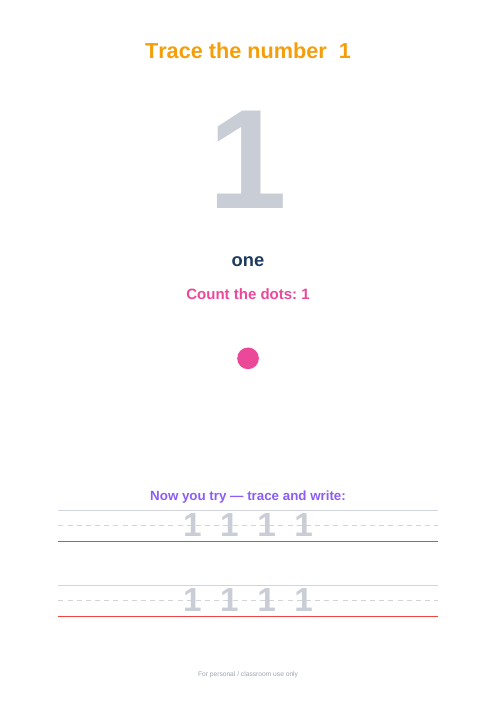
If you'd like print-and-go pages that pair counting with number formation — trace every numeral 1–20, count the dots, learn the number words — our Numbers 1–20 pack turns the skills in this guide into pages you can print as often as you like.
Practise this at home
Numbers 1–20: Trace & Count
21-page printable pack · £4.99 · Buy once. Yours forever. No subscription, no renewals.
Get the packParents also read
Number Formation 1-20: EYFS Guide
Number formation the UK-school way: the 0-9 rhymes teachers use, pencil grip stages by age, why reversals are normal, and how 11-20 build on 0-9.
Simple Addition for Ages 4–6
How to teach simple addition to 4–6 year olds the way UK schools do: concrete objects, then pictures, then written sums — with practical examples.
Shapes & Colours: What Reception Expects
What Reception actually expects your child to know about shapes and colours — 2D shapes, colour names and the honest truth about what's 'behind'.
Questions parents ask
What age should my child count to 10?
Most children recite to 10 between 3 and 4, and count objects reliably — one number per object, knowing how many — between 4 and 5. Both ranges are wide and both are normal. Worry less about the birthday and more about the pieces: if they can count five objects one-to-one and tell you 'five altogether', they're doing brilliantly.
My child skips numbers when counting — is that normal?
Completely. The sequence is learned like a song, and songs get muddled. Just model it back correctly — 'one, two, three, four, five' — without making it a correction. If they're still jumbling the order past 5, lots of stair-counting and hide-and-seek counting will sort it out.
Should I correct every miscount?
No — correct rarely and lightly. Every interrupted count teaches your child that counting is a performance you're judging. Model the right answer, celebrate the effort, and let accuracy arrive through repetition. Save corrections for when they're calm and receptive, not mid-game.
What's the difference between counting and number formation?
Counting is knowing how many — a thinking skill. Number formation is writing the numeral — a physical skill. A child can count to 20 long before they can write '17' legibly, and that's fine. Our number formation guide covers the writing side; this guide is the thinking side.
How do I teach 'how many?' without quizzing them constantly?
Narrate it yourself first: count their toys and announce 'six altogether!' while they listen. After a week of hearing it, start pausing before the total and let them fill it in. It becomes their idea, not your test.
Do I need special toys or an app?
No. Pasta, buttons, stairs, snacks and fingers have taught counting for generations. Dice and dominoes are nice for subitising if you have them. Save your money — the teaching is in how you count together, not what you count with.