 LittleLearners
🔢 Early Maths
Number Formation 1-20: EYFS Guide
The short answer
Number formation means writing each numeral the same way every time, so numbers stay legible. It is a handwriting habit — not an EYFS requirement. The rhymes UK teachers use most include: 0 — 'around and round and round we go'; 1 — 'start at the top and down we run'; 2 — 'around and back on the railroad track'.
What number formation actually is (and isn't)
Number formation is the habit of writing each numeral the same way every time. Same start point, same direction, same strokes — so every 3 looks like a 3 and every 7 looks like a 7.
Here is the part nobody tells parents: number formation is not in the EYFS statutory framework. The early learning goals cover understanding of number and correct letter formation — numeral handwriting is a classroom habit schools teach for legibility, not a box your child must tick.
That matters because there is no single 'correct' stroke order handed down from on high. Schools choose a method — usually with rhymes — and the golden rule is to match your child's school, not a random worksheet.
The 0-9 rhymes UK teachers actually use
The set below is the widely-shared version used by many UK primary schools. Wordings vary between schools — always check which set your child's school uses — but these are the rhymes behind thousands of classroom displays:
- 0 — 'Around and round and round we go, when we get home we have a zero.'
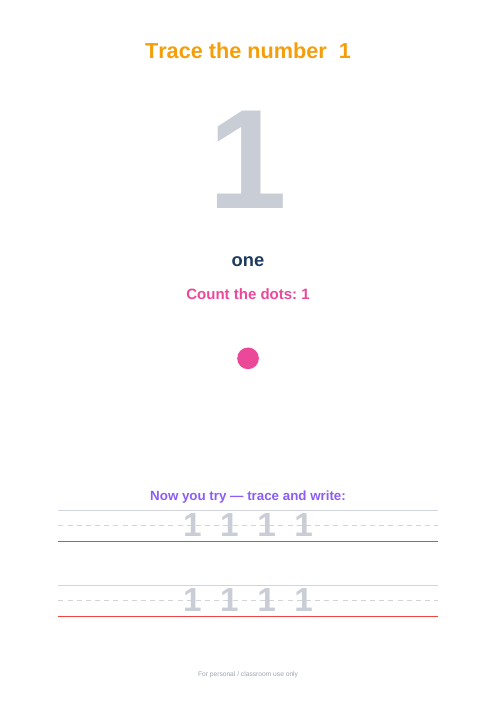
- 1 — 'Start at the top and down we run, that's the way we make a one.'
- 2 — 'Around and back on a railroad track, two, two, two.'
- 3 — 'Around the tree and around the tree, that's the way we make a three.'
- 4 — 'Down and over, down some more, that's the way we make a four.' (Lift the pencil between strokes.)
- 5 — 'Down and around, then a flag on high, that's the way we make a five.' (Lift the pencil for the flag.)
- 6 — 'Down we go and make a loop, number six makes a hoop.' (Underline it while learning, so it never becomes a 9.)
- 7 — 'Across the sky and down from heaven, that's the way we make a seven.'
- 8 — 'Make an 's' and do not wait, when it's joined up you have an eight.'
- 9 — 'Make a loop and then a line, that's the way we make a nine.' (Underline it too — the twin of 6.)
- Say the rhyme aloud while your child writes — the words pace the hand.
From 0-9 to 11-20: teens are just pairs
Master 0-9 first. Every teen is simply two known digits side by side: 13 is '1' then '3'. The new skill is saying the digits in order and writing left to right.
Count it, say it, write it: 'thirteen — one, three.' Point to each digit as you say it.
The tricky bit: teens don't sound like they look — fourteen isn't 'four-ten'. Say the number, then name the digits, and the connection builds with repetition.
Pencil grip: what's normal at each age
Grip develops in stages, and a proper tripod grip is not expected at three. This sequence comes from NHS paediatric occupational therapy guidance:
- Age 1-2: palmar supinate — whole fist around the crayon, the arm doing the work.
- Age 2-3: digital pronate — fingers point down at the crayon, wrist straighter.
- Age 3-4: static quadripod — four fingers hold the crayon, the hand moves as a unit.
- Age 4-6: static tripod — thumb and two fingers in the classic tripod, hand still moving as one.
- Age 5-7 and beyond: dynamic tripod — the fingers start moving the pencil independently. This is the mature grip.
- Don't force a tripod at three. Strengthen the hands instead: playdough, threading beads, tweezers and climbing all build the muscles writing needs.
Reversed 2s and 5s? Completely normal
Mirror writing — backwards 2s, 3s and 5s, or 6/9 mix-ups — is a normal developmental stage up to around age seven. It is not, on its own, a sign of dyslexia.
Gentle fixes that work: underline 6 and 9 every time (a trick many schools use), write the tricky numeral large with a starting dot, and model it once rather than rubbing it out five times.
If reversals persist heavily past seven or eight alongside other reading difficulties, mention it to the teacher. At four, five or six — relax.
When to start (and what comes before numbers)
Follow your child's interest, not a timetable. Before numerals, children need pre-writing patterns: vertical and horizontal lines, circles, crosses, zigzags and curves.
Go big before small: chalk on the patio, a paintbrush and water on the fence, finger-tracing in sand or shaving foam. Big shoulder movements build the control that small pencil work needs.
Five minutes of patterns beats twenty minutes of tearful number-tracing. When the patterns flow, the numerals follow.
Make it stick: five ways to practise
Formation improves with short, frequent practice — not marathon sessions. Five approaches that work:
- Say it as you write it. The rhyme paces the hand — chanting aloud is the single most effective trick.
- Start big. Whiteboard markers, chalk on the patio and finger-tracing in sand build the movement before pencil on paper.
- Use starting dots. A dot where the pencil begins removes half of all formation errors overnight.
- Little and often. Five minutes a day beats a weekly worksheet battle.
- Celebrate the readable ones. Circle the best-formed numeral on the page and say why — children repeat what gets noticed.
Match your child's school
Because rhyme sets and stroke orders vary, the school's way wins. Ask the teacher which rhymes they use — many schools send a formation sheet home in Reception.
Our numbers pack uses the widely-shared rhyme set above, with one page per numeral and starting dots, so home practice matches what most UK classrooms teach.
Legible, not perfect
The goal of number formation is modest and kind: numbers other people can read. Rhymes, starting dots and a little daily practice get you there — no drilling, no tears, no race.
If you'd like every numeral 1-20 as print-and-trace pages with starting dots and rhymes, our Numbers 1-20 pack has twenty pages ready to print.
Practise this at home
Numbers 1–20: Trace & Count
21-page printable pack · £4.99 · Buy once. Yours forever. No subscription, no renewals.
Get the packParents also read
Simple Addition for Ages 4–6
How to teach simple addition to 4–6 year olds the way UK schools do: concrete objects, then pictures, then written sums — with practical examples.
Shapes & Colours: What Reception Expects
What Reception actually expects your child to know about shapes and colours — 2D shapes, colour names and the honest truth about what's 'behind'.
Counting to 10: Fun Activities That Work
How to teach counting to 10: one-to-one correspondence, cardinality and subitising explained simply, plus counting games that work at home.
Questions parents ask
Does my child need to write numbers before starting Reception?
No. Number formation is not an EYFS requirement — the early learning goals focus on understanding number, not handwriting numerals. Schools introduce formation in Reception, and pre-writing patterns (lines, circles, zigzags) are the best preparation.
My child writes 3 backwards. Is that normal?
Yes — mirror writing is a normal developmental stage up to around age seven and is not, on its own, a sign of dyslexia. Gently model the correct way, underline 6 and 9 to tell them apart, and don't make a battle of it.
What is the correct pencil grip for a 4-year-old?
At four, most children use a static tripod or quadripod grip — and that's exactly right for their age. The mature dynamic tripod grip develops around 5-7. Build hand strength with playdough, threading and climbing rather than forcing finger positions.
Should we learn 1-20 or 0-9 first?
0-9 first, always. Every teen is just two known digits written side by side, so secure single digits before combining them. Count to 20 out loud as much as you like — but write 0-9 until they're automatic.
Our school uses different rhymes. Does it matter?
Use the school's. Rhyme sets vary between schools and none is officially 'correct' — what matters is one consistent method. Ask the teacher for their formation sheet and practise that.