 LittleLearners
🔢 Early Maths
Simple Addition for Ages 4–6
The short answer
Schools teach addition in three stages: concrete (real objects your child can touch), pictorial (pictures and dots), then written number sentences like 3 + 2 = 5. Keep each stage playful, let your child stay at the concrete stage as long as they need, and only move on when the pictures make sense to them.
What 'addition to 10' actually means at this age
In Reception, addition isn't sums — it's stories. 'You have 3 conkers, I give you 2 more, how many now?' Children combine two groups and count everything. That's addition, and it's the foundation everything else sits on.
In Year 1 the same idea becomes formal: number sentences like 3 + 2 = 5, and the famous 'number bonds to 10' — the pairs that make 10. The national curriculum expects Year 1 children to read, write and interpret these sentences and to know their bonds to 10 by heart.
The honest truth: children who rush to written sums before they truly understand combining groups end up memorising procedures they don't understand. The slow road through objects and pictures is the fast road in the end.
Stage 1: concrete — real things you can touch
Start with objects, not numbers. Counters, dried pasta, conkers, toy cars — anything countable. The language matters more than the equipment:
- Put out 3 apples. 'How many apples?' (count together)
- Add 2 more. 'And 2 more. How many altogether now?'
- Let your child count all of them: 1, 2, 3, 4, 5.
- Say what happened: '3 apples and 2 more apples makes 5 apples altogether.'
Stage 2: pictorial — when objects become pictures
Once combining real objects is easy, draw the story. Three circles, then two more circles — how many altogether? Dot patterns under numbers work the same way: the dots are the objects, flattened onto paper.
The ten frame is the teacher's favourite tool here, and it's simple: a 2×5 grid. Fill 3 squares with counters, add 2 more, and your child sees 5 — and sees the 5 empty squares that make the rest of 10. It builds the visual sense of number that written sums can't.
Stay at this stage until your child looks at 3 dots + 2 dots and just knows it's 5 without counting each one. That 'just knowing' is the goal — it's called subitising, and it's the seed of mental maths.
Stage 3: written — first number sentences
Only now introduce symbols. Write '3 + 2 = 5' and read it as a sentence: 'three add two equals five'. Teach each symbol's meaning deliberately:
- + means 'and' or 'add' — we're combining groups
- = means 'is the same as' or 'makes' — not 'write the answer here'
- Read the whole sentence aloud every time, not just the answer
Number bonds: the facts worth knowing by heart
Number bonds are pairs of numbers that combine to make another number — most importantly, the pairs that make 10: 1+9, 2+8, 3+7, 4+6, 5+5. Year 1 expects children to recall these without counting, because every harder calculation leans on them.
Build them through games, not drilling: pairs snap with number cards, 'make 10' with a ten frame and counters, or the classic — hold up some fingers, your child holds up the rest to make 10.
Doubles deserve special attention: 1+1 through 5+5. Children learn these fastest of all, and 'double 4 is 8, so 4+5 is one more' becomes a strategy for near-doubles later.
The counting-on trap (and how to avoid it)
Watch how your child solves 3 + 2. If they count '1, 2, 3… 1, 2' and then count everything again from 1, they're counting all — correct but slow. The next step is counting on: start at 3, then '4, 5'.
Don't rush this transition. Counting all is a valid strategy and pushing counting-on too early causes errors. It emerges naturally once number bonds strengthen — a child who just knows that 3 and 2 make 5 has no counting left to do at all.
And fingers: let them. Finger counting is a legitimate mathematical tool at this age, not a bad habit. It fades on its own as mental strategies take over.
Common mistakes and how to fix them
Adding the wrong groups: in '3 + 2', some children count 3, then count 2 more starting from 3 again (getting 6). Physically separate the groups — then push them together — and narrate: '3 here, 2 here, now altogether.'
Too-big numbers too soon: if 7 + 5 is guesswork, drop back to totals under 6. Confidence with small numbers transfers upward; anxiety with big numbers doesn't transfer at all.
Symbol confusion: '=' read as 'the answer is' leads to nonsense like '3 + 2 = 5 + 1 = 6'. Keep reading it as 'is the same as' and the logic holds.
Rushing to written work: if written sums produce tears but objects produce smiles, the objects are telling you the truth about where your child is. Go back a stage without apology.
Making it part of everyday life
The best addition practise doesn't look like maths: setting the table ('we need 4 plates, there are 2 — how many more?'), baking ('3 eggs in, 2 more to crack'), stairs ('we've climbed 5, how many to 10?'), shopping ('2 apples and 3 bananas — how many pieces of fruit?').
Five minutes of this, woven into the day, does more than any worksheet — though worksheets have their place once the concept is secure, giving children the written practise schools expect.
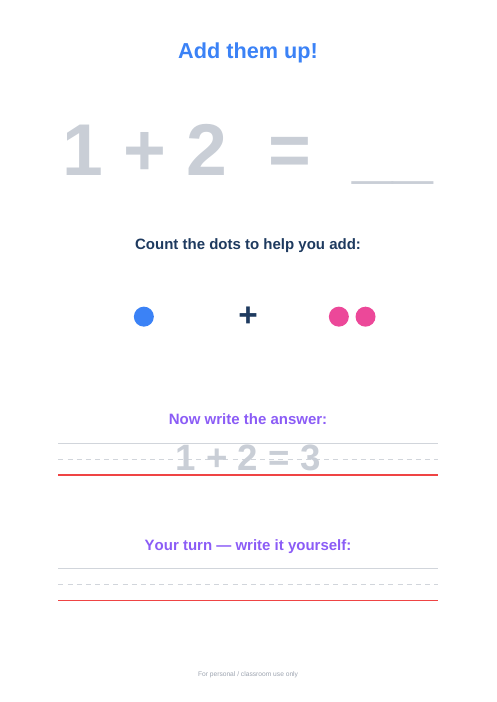
If you'd like that written practise ready to print — every addition fact to 10 with counting dots, traceable equations and a mixed review page — our simple addition pack is built to follow this exact concrete-to-written path.
Practise this at home
Simple Addition to 10
12-page printable pack · £4.99 · Buy once. Yours forever. No subscription, no renewals.
Get the packParents also read
Number Formation 1-20: EYFS Guide
Number formation the UK-school way: the 0-9 rhymes teachers use, pencil grip stages by age, why reversals are normal, and how 11-20 build on 0-9.
Shapes & Colours: What Reception Expects
What Reception actually expects your child to know about shapes and colours — 2D shapes, colour names and the honest truth about what's 'behind'.
Counting to 10: Fun Activities That Work
How to teach counting to 10: one-to-one correspondence, cardinality and subitising explained simply, plus counting games that work at home.
Questions parents ask
When should my child start learning to add?
Informally in Reception: combining groups of objects and counting altogether. Formally in Year 1: written number sentences and number bonds to 10. Before Reception, just count everything together — that's the prequel.
Is counting on fingers okay?
Yes — it's a genuine mathematical strategy at this age, not a crutch. Children naturally move to mental methods as their number bonds strengthen. Banning fingers just removes a tool they need.
What exactly is a number bond?
Two numbers that combine to make another number — usually discussed as the pairs making 10 (7+3, 6+4…). Knowing bonds to 10 by heart is a Year 1 expectation because they're the building blocks of all later addition.
Should I teach subtraction at the same time?
It arises naturally — 'we had 5 biscuits, we ate 2, how many left?' uses take-away language children understand. Schools teach them as connected ideas (5 = 3 + 2, so 5 − 3 = 2). Follow your child's curiosity; no need for a separate subtraction campaign.
My child adds fine with objects but freezes on paper — help?
Completely normal, and the message is clear: stay at the pictorial stage longer. Draw the objects, use ten frames, and only return to written sums when the pictures feel easy. Paper isn't harder maths — it's just a less familiar representation.
Worksheets or real objects — which is better?
Objects first, always. Worksheets are for practising a concept that's already understood, not for teaching it. A child who can show 4 + 3 with pasta can learn the written form in minutes; a child drilled on worksheets without the objects often can't apply it anywhere else.