 LittleLearners
Phase 4 Phonics: Words with Adjacent Consonants (Free Pack)
Phase 4 is the step where reading gets trickier — not because of new sounds, but because words grow extra consonants. Here's what it is, how to practise it, and a free pack of words to print. No sign-up, no cost.
7 pages · CVCC & CCVC word lists · Sort-the-words activity · Syllable clapping · Decodable sentences · Answer key
The big surprise: Phase 4 has no new sounds
Phases 2 and 3 teach the sounds. Phase 4 teaches children to use them in longer words. Every letter in a Phase 4 word is already known — the challenge is blending two or three consonants that sit next to each other, without dropping one. That's why a child who reads cat perfectly can still read hand as "han" or stop as "top".
Two consonants together, each keeping its own sound, are called adjacent consonants. They appear at the start of a word, at the end, or both:
Adjacent consonants at the start of words (CCVC)
| Adjacent consonants | Example words |
|---|---|
| bl, cl, fl, gl, pl, sl | blob, clap, flag, glad, plop, slip |
| br, dr, fr, gr, pr, tr | bran, drip, frog, grab, pram, tram |
| sk, sm, sn, sp, st, sw, tw | skip, smell, snip, stop, swim, twig |
| spr, str, spl (three letters) | spring, street, split, strap, string |
Notice the pattern: each pair is two separate sounds. Stop is s-t-op, not "stop" as one blob. Robot-talking — saying each sound slowly, then sweeping them together — is the fix when a child drops one.
Adjacent consonants at the end of words (CVCC)
| Adjacent consonants | Example words |
|---|---|
| mp, nd, nk, nt | jump, hand, bank, tent |
| st, ft, ld, lp, lt, sk | lost, left, held, help, belt, ask |
End clusters are usually the harder half: children hear the vowel and the first consonant and stop. Practise by asking them to say the word slowly and hold up a finger for every sound they hear — hand gets four fingers, not three.
Longer words: clap the syllables
Phase 4 also brings polysyllabic words — words with more than one syllable: children, lunchbox, sandwich, windmill, shampoo, chimpanzee. The trick is clapping: one clap per syllable. Windmill is just two easy words stuck together — wind + mill. Once a child sees that, long words stop being scary.
One trap to teach explicitly: digraphs are not clusters
Ch, sh, th and ng look like two letters, but they are one sound — a digraph. Children must never try to sound them as two separate letters. If your child is blending shop as "s-h-op", that one distinction fixes it.
Phase 4 tricky words
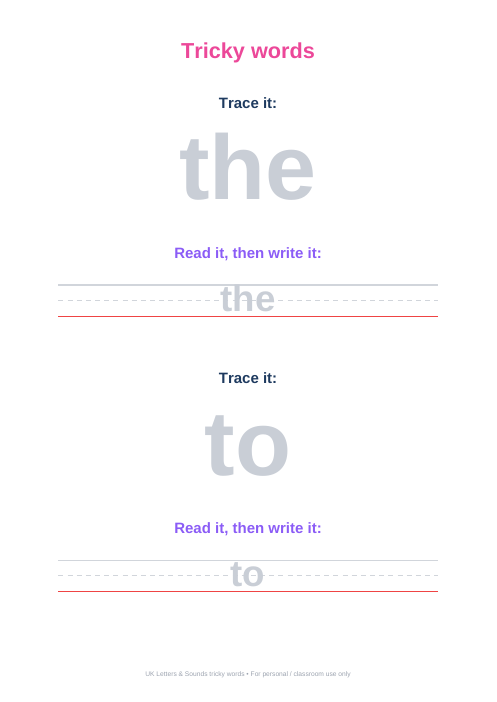
Phase 4 also introduces fourteen tricky words — words that can't be fully sounded out yet: said, have, like, so, do, some, come, were, there, little, one, when, out, what. These are covered year by year on our common exception words page — learn them by sight, a few at a time, alongside the blending practice.
How to practise Phase 4 at home
- Sound buttons. Put a dot under each letter of a word and press each dot as you say its sound — including both consonants in a cluster. It makes dropped sounds visible.
- Robot talk. Say a word as a robot would (h-a-n-d), then sweep it together fast. Slow, then fast — never fast and wrong.
- Clap long words. One clap per syllable before reading the word. Children who clap first almost never guess.
- Read real sentences. Single words are drills; sentences are reading. Our pack's sentence page is the bridge — decodable, with Phase 4 words inside real meaning.
- Short, daily, silly. Five minutes of cluster words beaten into a game (who can say crisp the fastest without dropping a sound?) beats a worksheet marathon.
More free phonics practice
Questions parents ask
What comes after Phase 4?
Phase 5, usually in Year 1: new graphemes (ay, ou, ie, ea) and alternative pronunciations of sounds children already know. Phase 4 must feel solid first — rushing to Phase 5 with dropped consonants just moves the problem.
My child drops the second consonant ("han" for hand). How do I fix it?
Slow it right down: h-a-n-d, one finger per sound, then sweep together. Sound buttons help — a dot under every letter, pressed as each sound is said. A few minutes a day for a week usually fixes it.
Is Phase 4 taught in Reception or Year 1?
Usually the end of Reception into the start of Year 1, depending on the scheme (Little Wandle and Read Write Inc. sequence it slightly differently). Follow your child's school order — the phases matter more than the exact term.
Are digraphs like 'sh' part of Phase 4?
No — and this is the key distinction. Digraphs (ch, sh, th, ng) are one sound spelled with two letters, taught in Phase 3. Phase 4 clusters (st, bl, mp) are two sounds sitting side by side.
Should we practise tricky words at the same time?
Yes, a few at a time, by sight — not by sounding out. Our common exception words page has the full Phase 4 list with practice ideas.