 LittleLearners
Letter Formation Worksheets & How Letters Are Really Taught
Children don't learn to write letters from A to Z — they learn them in families that share the same starting movement. Here's how it works, plus free printable practice. No sign-up, no cost.
Why starting points matter more than neatness
A letter can look right yet be formed the wrong way — started at the bottom, or drawn clockwise. That matters. Wrong stroke patterns are hard to unlearn, they slow writing down later, and they're behind many letter reversals (the famous b and d mix-up). Schools therefore teach where each letter starts and the direction the pencil travels, right from Reception. The government's Writing Framework (2025) is explicit: correct formation should be taught from the very beginning, in small steps, with lots of practice.
The four letter families
Group letters by their first movement and each new letter feels familiar:
- Curly Caterpillars — c, a, d, o, g, q, s, f, e. All begin with an anti-clockwise curve, starting at about 2 o'clock. Learn c first ("curl around") and the rest borrow its shape: a is "round, up, down and flick"; d is "round, up, up, down".
- Long Ladders — l, i, t, u, j, y. Start at the top and pull straight down.
- One-Armed Robots — r, n, m, h, b, p, k. Down, back up, then branch over to the right.
- Zig-Zag Monsters — v, w, x, z. Diagonal strokes only.
Teaching b inside its robot family (starting with the long down-stroke) is one of the best defences against b/d confusion, because d starts with the caterpillar curve instead — the two letters feel completely different to write.
Practising at home — what actually helps
- Go big first. Chalk on the pavement, a finger in a sand tray, letters in shaving foam. Big movements teach the pattern; pencils refine it later.
- Say the rhyme as they write. Short verbal cues ("down, up and over") fix the sequence in memory.
- Tripod grip. Shorter pencils or snapped crayons encourage a proper grip — there's less to grab hold of.
- Wide lines. Young writers need generous line height; narrow lines come later.
- Little and often. Around 15 minutes, three times a week, beats one long session.
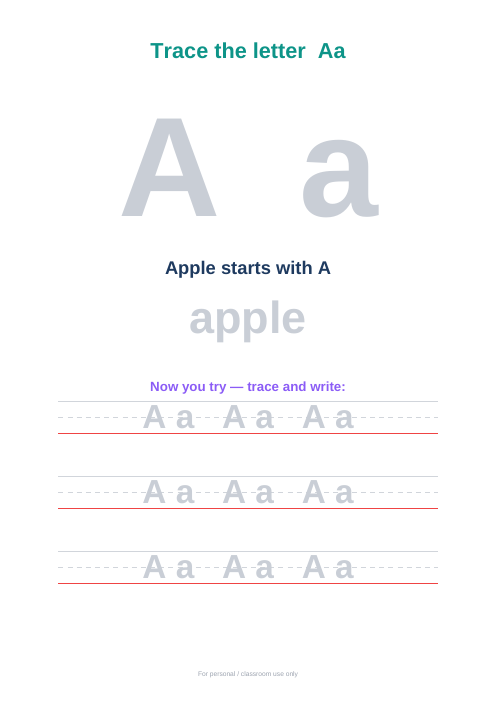
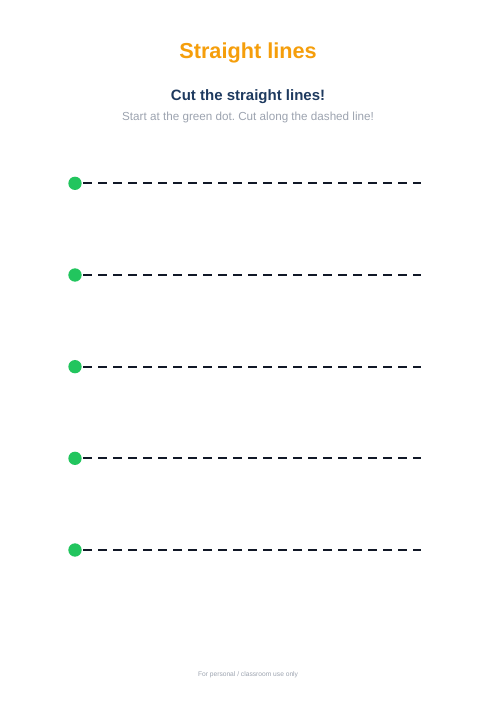
Free printable practice
Questions parents ask
Should my child learn capital letters or lowercase first?
Lowercase letters come first in UK schools, because nearly all reading text is lowercase. Capitals are taught alongside, starting with the first letter of your child's name.
My child writes letters backwards. Should I worry?
Reversals are common until about age 7. Teaching letters in families, with correct starting points, reduces them. If reversals persist well into Year 2 alongside other difficulties, mention it to the teacher.
Does it matter if my child starts letters at the bottom?
Yes — stroke order affects fluency, joining and speed later. It's much easier to build the right pattern now than to correct it in Year 3.
What if holding a pencil is the problem, not the letters?
That's pre-writing territory: scissor practice, mazes, dot-to-dot and playdough all build the hand strength and pencil control that letter formation needs.