 LittleLearners
Free English Worksheets for EYFS & KS1 (Ages 3–6)
Reading, spelling and handwriting — the English skills UK schools teach in EYFS and KS1. Each page below explains one skill simply and links a free printable pack. No sign-up, no cost.
English topics
Reading Comprehension
Six short stories with questions for Year 1 & Year 2.
Common Exception Words
The Year 1 & Year 2 tricky words that break the rules — with practice ideas.
KS1 Spelling Lists
Every Year 1 & Year 2 spelling pattern, with a free practice pack.
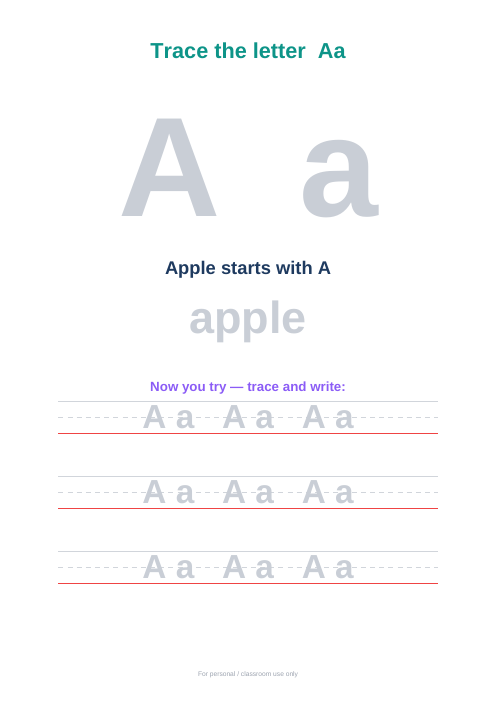
Letter Formation
The four letter families, stroke order and pencil grip for ages 3–6.
Free English packs
English guides for parents
Tricky Words Phases 2–3: Full List & Tips
All the Phase 2 and 3 tricky words from Letters & Sounds, plus practical ways to help your child learn the words that can't be sounded out.
Pre-Writing Skills Before Letters
Before letter tracing: the pre-writing strokes — lines, curves, zigzags and shapes — that build the hand control children need for writing.
Pencil Grip Guide for Parents: Ages 3–6
The tripod grip explained for parents: how pencil grip develops, what to model, practical exercises — and what not to correct too early.
Questions parents ask
What are common exception words?
Words that break the usual spelling rules — like said, was and one — so children can't sound them out fully. They're learned by sight, a few at a time, which is why they have their own page and lists.
How can I help with spelling without weekly tests?
Try Look–Cover–Write–Check: look at the word, spot the tricky bit, cover it, write it from memory, then check. It works for spelling patterns and exception words alike.
What if my child hates handwriting practice?
Keep it tiny and physical first: short pencils or broken crayons encourage a natural tripod grip, and big movements (chalk, paint, tracing in sand) build the same muscles before pencil-and-paper work.