 LittleLearners
🔤 Phonics & Early Reading
Tricky Words Phases 2–3: Full List & Tips
The short answer
Phase 2 tricky words: the, to, I, no, go (some lists add into). Phase 3 tricky words: he, she, we, me, be, was, you, they, all, are, my, her. Because these words break phonic rules, children learn them by sight — look, say, cover, write, check — a few minutes a day, mixed with plenty of blending practise.
What makes a word 'tricky'?
Most early words play fair: s-a-t says sat, p-i-n says pin. Tricky words don't. They contain spellings your child hasn't been taught yet, so sounding them out gives the wrong answer — try sounding out 'was' with Phase 2 knowledge and you get 'wass'.
That doesn't mean they're random. Every tricky word becomes decodable later, once the relevant spelling patterns are taught. 'Tricky' just means 'not yet'. Children learn them by recognising the whole word on sight, while their phonics knowledge catches up underneath.
You may also hear them called 'common exception words' — that is the term some phonics schemes use for exactly the same idea. If your child's school says 'red words' (Read Write Inc.) or 'tricky words' (Letters & Sounds, Little Wandle), they mean the same thing: learn these by sight for now.
The complete Phase 2 list
The original Letters & Sounds programme lists five tricky words for Phase 2. Here they are, with the bit that trips children up:
- the — the 'th' and the 'e' aren't taught yet; children just have to know it
- to — the 'o' says 'oo', which nothing in Phase 2 explains
- I — always a capital, and it says its letter name, not a sound
- no — the 'o' says 'oh', not the short 'o' of 'dog'
- go — same story as 'no': the 'o' is saying its name
- One more note: some school lists show six Phase 2 tricky words, adding 'into'. This isn't a mistake — several DfE-validated schemes teach it at this point because children meet it so often in early books ('the frog jumped into the pond'). If your school's list has six words, learn six. The list that matters is the one your child's teacher sends home, not the one on any website — including this one.
The complete Phase 3 list
Phase 3 introduces twelve more. By the end of the phase your child is expected to read all of these on sight:
- he, she, we, me, be — the 'e' says its name ('ee'), which Phase 3 hasn't explained yet
- was — the 'a' is saying 'o' (as in 'wasp'); one of the hardest for children to accept
- you — the 'ou' spelling is a Phase 5 job, so for now it's pure memory
- they — the 'ey' says 'ay'; children want to read it as 'th-ee'
- all — the 'a' is really an 'or' sound before the double l
- are — the 'a' is really an 'air' sound
- my — the 'y' says 'eye'; a Phase 5 pattern hiding in a Phase 3 word
- her — the 'er' spelling isn't taught until later
How schools teach them: look, say, cover, write, check
Schools don't hand children a list of seventeen words and wish them luck. They introduce two or three at a time, practise them for a few minutes daily, and keep revisiting old ones. The classic routine is 'look, say, cover, write, check':
- Look at the word carefully — trace its shape with a finger
- Say it out loud
- Cover it (or turn the card over)
- Write it from memory — in sand, with chalk, with a finger in the air
- Check: uncover and compare, letter by letter
Five games that actually work
Drilling flashcards at the kitchen table gets old fast — for both of you. These games teach the same words with far less complaining:
- Tricky word hunt: write words on sticky notes and hide them round the house. Your child reads each one to 'collect' it.
- Snap: make pairs of word cards and play snap. Speed builds recognition faster than staring.
- Silly sentences: 'The goat said no to the...' — your child fills in a tricky word and draws the scene.
- Word building: build the word with magnetic letters, then ask 'which bit CAN we sound out?' ('sh' in 'she' is fine — it's only the 'e' that's tricky). This keeps phonics and sight words connected instead of separate.
- Roll and read: write six words in a grid, roll a dice, read the word you land on. First to read all six wins.
Mistakes that slow children down
The most common one is too many words at once. Seventeen words feels like a mountain; three words feels like a game. Schools drip-feed them across two terms — do the same at home.
Second: practising only by staring. Tricky words stick through writing them, finding them in books, and using them — not through being shown a card twenty times in a row.
Third: stopping too soon. A word your child 'knew' last week will often vanish this week. That is the normal forgetting curve, not a problem with your child. Revisit old words for a minute or two each session and they come back quickly.
When to worry (and when not to)
Not yet knowing all the words: normal. Forgetting words they knew: normal. Reading 'was' as 'wass' sometimes: completely normal — it shows their phonics is working and the sight memory just needs more time.
What is worth mentioning to the teacher: if after several months of school your child recognises almost no words at all, avoids all reading, or seems unable to remember words from one day to the next despite daily practise. Teachers see the full picture across the class and will tell you honestly whether it's developmental pace or something to look at together.
One practical check you can do yourself: is your child actually seeing the words clearly? If they squint, rub their eyes, or hold books very close, mention it at their next eye check — it's a quick thing to rule out.
Keep it short, keep it playful
Tricky words are a marathon, not a sprint — they keep appearing right through primary school. The families who do best are the ones who fold five minutes of word play into the day and forget about it, not the ones who run nightly flashcard boot camps.
If you'd like the practice pages to go with the games — every Phase 2 and 3 tricky word with trace, read and write-it-yourself pages — our tricky words pack covers the full list in printable pages you can reuse as often as you like.
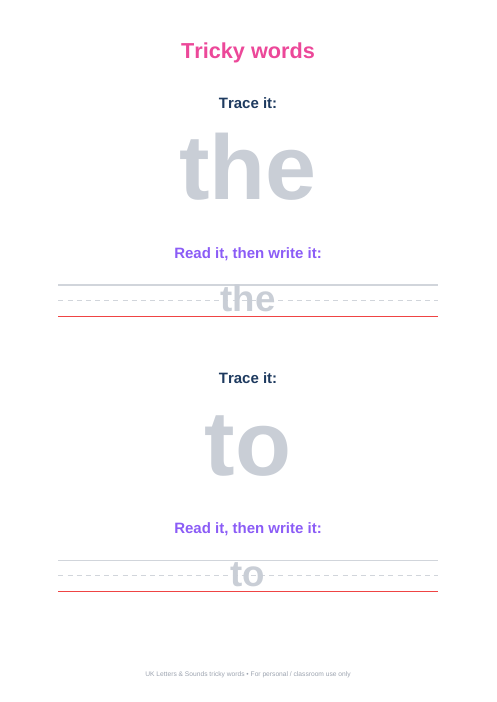
Practise this at home
Tricky Words: Phases 2 & 3
11-page printable pack · £4.99 · Buy once. Yours forever. No subscription, no renewals.
Get the packParents also read
Phase 2 Phonics Sounds in Order
Phase 2 sounds in teaching order — all five sets with pure-sound pronunciation tips, first blending words and a 5-minute daily routine.
What Is Phonics Phase 2? (UK)
Phase 2 phonics explained for UK parents: what children learn in Reception, when it's taught, the full phase timeline and 5 things to do at home.
Phonics at Home: A 10-Minute Daily Routine
A practical 10-minute daily phonics routine for parents — revisits, blending games and writing practice that mirror what UK schools do in Reception.
Questions parents ask
How many tricky words should a 5-year-old know?
By the end of Reception, most children read the Phase 2 and 3 lists — around seventeen words. But schools introduce them gradually across the year, so don't expect the full list in the autumn term. Learn your school's current words, not the whole list at once.
My child keeps forgetting 'the' — is that normal?
Completely. 'The' is the most common word in English and one of the hardest to memorise because there's nothing to hook it to. Keep it in daily rotation with the look-say-cover-write-check routine and it will stick — then vanish, then stick again. That's how memory works at this age.
Are tricky words the same in every phonics scheme?
Largely, yes — the Letters & Sounds lists are the reference most schemes build on. Read Write Inc. calls them 'red words' and groups a few slightly differently, but the words your child needs are essentially the same. Always follow your school's list for homework.
Should I teach letter names with tricky words?
It's fine — tricky words are learned as whole words anyway, so letter names don't confuse the process the way they can with blending. Many parents spell them out ('t-h-e, the') as a chant, which works well.
Can we start tricky words before school?
Gently, yes. A couple of high-frequency words like 'the' and 'I' crop up in every bedtime book, so pointing them out in stories is natural pre-school practise. Keep it to noticing and playing — the formal lists start in Reception.
What's the difference between tricky words and high-frequency words?
High-frequency words are simply words children meet a lot (and, it, is). Many are decodable and children blend them. Tricky words are the high-frequency words that can't be sounded out yet — the subset that needs sight learning.