 LittleLearners
🔤 Phonics & Early Reading
Blending CVC Words
The short answer
Blending is pushing letter sounds together to read a word: c-a-t becomes 'cat'. Start once your child knows most Phase 2 sounds. Say each sound purely ('c-a-t', not 'cuh-ah-tuh'), run the sounds into each other, then say the whole word fast. Five to ten minutes a day is plenty — it usually clicks within weeks.
Blending, in plain English
Blending is the moment phonics turns into reading. It means pushing individual letter sounds together to make a word: your child sees c-a-t, says each sound, then joins them into 'cat'. Every word they will ever read — from 'dog' to 'extraordinary' — is read this way.
It is worth knowing the word because schools use it constantly. 'Sound it out' and 'blend it' mean the same thing. The reverse — pulling a word apart into its sounds, like 'cat' into c-a-t — is called segmenting, and it is how children learn to spell. The two skills grow together.
The good news: blending is a small, teachable skill, not a talent. Most children get it within weeks of starting, and you can practise it at the kitchen table with nothing but your voice.
First, the sounds must be pure
Blending only works if the sounds going in are clean. If your child says 'cuh-ah-tuh', no amount of pushing will make 'cat' — the extra 'uh' sounds get in the way. This is the single biggest reason blending stalls at home.
Stretchy sounds should stretch: sss, mmm, nnn, fff, lll, rrr. Bouncy sounds should be short and crisp: c, t, p, d, g — tiny taps, never 'cuh' or 'tuh'. Short vowels stay short: a as in apple, e as in egg, i as in insect, o as in orange, u as in umbrella.
Do not drill this separately for long. Practise pure sounds inside blending itself: every time you model c-a-t turning into 'cat', you are teaching both skills at once.
'Say it slowly, then say it fast'
This is the whole technique, and it is all you need: say the sounds slowly and robotically, then say the complete word fast and naturally. Model it like this, sweeping your finger under the letters as you go: 'c… a… t… (pause)… cat!'
Two small tricks make it work. First, do not leave gaps between the sounds — run them into each other like a slide: 'cccaaatt' rather than 'c. a. t.' Words built from stretchy sounds (s, m, n, f, l, r) make this easy, so start with those. Second, always finish with the fast, natural word, said with a smile — that is the reward the brain remembers.
Take turns: you do the slow robot part, your child does the fast word. Then swap roles. Within days, most children start doing both halves themselves.
30 words to start with
Start with words made of sounds your child already knows, and keep the vowels short. Grouping by vowel makes the pattern obvious — read one group a few times across a week before moving on.
- a-words: cat, sat, mat, pat, tap, pan, map, bag, hat, ran
- e-words: pen, hen, ten, pet, red, bed
- i-words: pin, bin, sit, pit, pig, fin
- o-words: dog, log, pot, mop, cot
- u-words: cup, bus, sun, run, mud
Five games that make blending stick
Blending practised as a game beats blending practised as a worksheet, every time. Five minutes of any of these counts as a full session.
- Robot talk: speak in robot sounds at breakfast ('pass the m-i-l-k') and let them blend it back. They will beg for more.
- Mystery bag: put toy animals in a bag, pull one out and sound out its name — 'd-o-g!' — before they guess which one it is.
- Word hop: write CVC words on paper plates on the floor; they hop to the word you sound out.
- Silly sentences: 'The cat sat on the… m-a-t!' — pause and let them finish it.
- Shopping list: write a CVC shopping list (jam, ham, bun, egg) and 'read' it together at the shops.
- End every game the second the fun dips. Five happy minutes beats twenty tired ones.
When they guess instead of blending
Most children go through a guessing phase: they see the first letter and the picture and announce a word. It is actually a clever strategy — just the wrong one for learning to read.
Do not scold it; redirect it. Cover the picture with your thumb and say, 'Let's check with the sounds.' Model the blend once, then let them try. When the blended word matches the picture, point that out: 'See? The sounds told us!'
If guessing is constant, the words may simply be too hard. Drop back to sounds they know cold and build up again — confidence is the fuel here.
When it clicks — and when to ask the teacher
Blending often clicks suddenly: weeks of robot talk, then one day they just read the word. That leap is normal. After it, keep practising — fluency, reading smoothly without the robot voice, takes months of easy, enjoyable reading.
Every child has their own timeline, but mention it to the teacher if: after several months of Reception your child still cannot hold three sounds in memory; they consistently cannot hear the sounds in spoken words (rhyming games and silly sound play help here); or reading is becoming upsetting. Teachers see this every year and will know exactly what to do.
If you'd like the words as print-and-go cards — every Phase 2 sound with blending words matched to the teaching sets — our Phase 2 phonics pack has them ready to print.
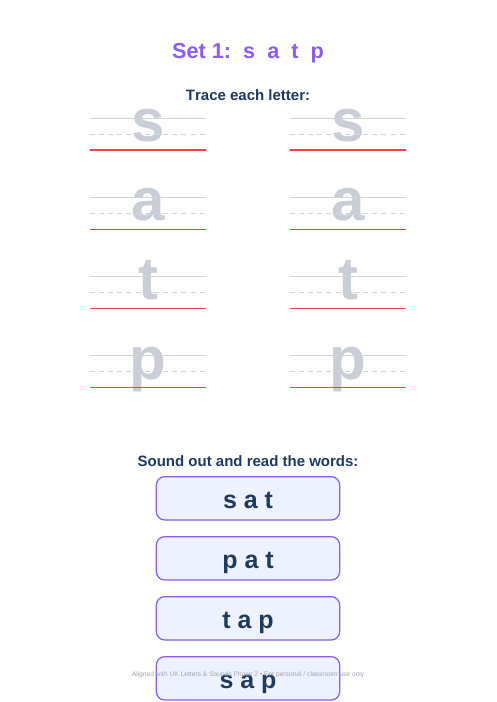
Practise this at home
Phonics Phase 2 (Letters & Sounds)
6-page printable pack · £3.99 · Buy once. Yours forever. No subscription, no renewals.
Get the packParents also read
Phase 2 Phonics Sounds in Order
Phase 2 sounds in teaching order — all five sets with pure-sound pronunciation tips, first blending words and a 5-minute daily routine.
What Is Phonics Phase 2? (UK)
Phase 2 phonics explained for UK parents: what children learn in Reception, when it's taught, the full phase timeline and 5 things to do at home.
Tricky Words Phases 2–3: Full List & Tips
All the Phase 2 and 3 tricky words from Letters & Sounds, plus practical ways to help your child learn the words that can't be sounded out.
Questions parents ask
What exactly is a CVC word?
Consonant-vowel-consonant: three sounds in three letters, like cat, pin and dog. They are the first words children read because each letter makes its usual sound — no tricks. A few short words that look simple but are not decodable, like 'the', come later as tricky words.
When should my child start blending?
Once they know most of the Phase 2 sounds — usually during the autumn or spring of Reception. Schools start blending within weeks of teaching the first sounds. There is no prize for starting earlier; knowing the sounds securely matters more than rushing ahead.
My child can say the sounds but can't join them — help?
This is the most common sticking point. Shorten the gaps between sounds until they run together ('cccaaat' instead of 'c… a… t'), and always model the fast word at the end. Start with stretchy-sound words like 'sun' and 'man', which are physically easier to slide together.
How long should we practise each day?
Five to ten minutes, little and often. Two short sessions beat one long one, and stopping while it is still fun keeps them willing to come back tomorrow.
Letter names or letter sounds for blending?
Sounds, always, for blending: 'c-a-t', never 'cee-ay-tee'. Letter names are useful later for spelling aloud and reciting the alphabet, but they get in the way of reading.
My child reads a word, then forgets it on the next page — is that normal?
Completely. Early reading lives in short-term memory; words become automatic only after many encounters. Re-reading favourite books is the mechanism, not a failure — repetition is literally how the brain files words away.