 LittleLearners
🔤 Phonics & Early Reading
Phonics Screening Check Explained
The short answer
The phonics screening check is a short, low-key DfE assessment in June of Year 1: your child reads 40 words aloud one-to-one with their teacher — 20 real words and 20 made-up 'alien' words that test pure decoding. The pass threshold is usually 32 out of 40. Children below it get extra support and retake it in Year 2. Daily reading and playful blending practice at home is the best preparation; cramming is unnecessary and counterproductive.
What the check actually is
Every June, children in Year 1 in England sit the phonics screening check — a statutory Department for Education assessment that takes about five to ten minutes per child. It is administered one-to-one by a teacher your child knows, usually in a quiet corner of the classroom, and it is deliberately designed to feel undramatic: no hall, no rows of desks, no exam atmosphere.
The check itself is simple. The teacher shows your child 40 words, one at a time, and the child reads each one aloud. Twenty are real words (like 'farm' or 'thorn'); twenty are pseudo-words — made-up words like 'vap' or 'blard' — each printed next to a picture of a friendly alien. The teacher notes which words are read correctly. That is the whole event.
It is worth knowing what the check is for: it is a diagnostic for schools, not a verdict on your child. Its purpose is to identify children who need extra phonics support early, while there is still plenty of time to give it. Schools use the results to plan intervention; the DfE uses national results to track standards. Neither use is about labelling your five- or six-year-old.
When it happens and what your child will experience
The check takes place in the summer term, normally during a designated week in June — schools choose the exact day. Your child's school will usually mention it in a newsletter or parents' evening beforehand, but many deliberately keep it low-key so children do not arrive anxious.
From your child's perspective, it feels like a reading game with their teacher. They are shown the alien words first or mixed in — teachers are trained to present pseudo-words positively ('this is an alien word, just sound it out') so children do not freeze at a word they have never seen. There is no timer; the teacher simply moves on if a child struggles, and encouragement is constant.
If your child is absent that week, the school arranges for them to take it on their return — there is a window, not a single do-or-die day. If you are worried about anxiety, mention it to the teacher; they administer this check every year and are well practised at keeping it relaxed.
The pass mark and what the score means
The threshold — the score that counts as meeting the expected standard — has been 32 out of 40 every year since the check began, and while the DfE confirms it after each year's check, parents can safely assume 32 remains the bar. Your child's school reports the outcome to you, usually as part of the end-of-year report: whether your child met the standard.
Meeting the standard means your child's decoding is on track — nothing more needs doing beyond the daily reading you are already doing. Not meeting it is not a failure and carries no consequences for your child: it simply triggers extra phonics support in Year 2 and a retake the following June. A significant minority of children retake it, and most pass the second time.
One thing the score does not tell you is how well your child understands what they read. The check measures decoding only — turning letters into sounds. Comprehension is assessed separately through normal classroom work. So a high score is good news about decoding, but keep reading stories together and talking about them: understanding is the other half of reading.
Why the alien words exist (the clever bit)
Parents sometimes ask why the check includes made-up words at all — surely reading real words is the point? The alien words are actually the most important part of the design. A child can 'read' a familiar real word from memory without decoding a single letter; with a pseudo-word, memory cannot help. The only way to read 'strom' correctly is to sound out s-t-r-o-m and blend it — which is exactly the skill being tested.
This is also why you should not be alarmed if your child finds the alien words strange or funny. Every child meets them for the first time in the check, which is precisely what makes them a fair test. Some teachers introduce alien-word games in the weeks before, so the format is familiar even though the words are new.
There is a small trap to avoid at home: drilling your child on lists of nonsense words until they memorise them. That defeats the purpose and, worse, teaches them that reading is about memorising odd strings. A little playful exposure to the format is plenty — the real preparation is blending real words confidently.
How to help at home (without turning it into a thing)
The single most effective preparation is also the simplest: read with your child every day, and let them do some of the reading. Ten minutes of your child sounding out words in a book they enjoy builds more decoding skill than any amount of check-specific practice, because it trains blending in context — which is what the check rewards.
If you want to practise the skill directly, keep it playful and brief. Robot talk is the classic: you say a word in sounds ('c-a-t') and your child blends it into the word. Flip it for segmenting: you say 'dog', they chop it into d-o-g. Five minutes, a few times a week, is ample — and stop the moment it stops being fun.
- Read daily and let them read some words aloud — real books beat word lists.
- Play robot-talk blending games: you segment, they blend, then swap roles.
- Try a few alien words as a silly game ('how would an alien say…?') so the format is not a surprise.
- Keep sessions to five or ten minutes; little and often beats long and miserable.
- Praise the sounding-out, not just the right answer — effort at blending is the skill being built.
- If you'd like structured blending practice at home, our Phase 2 phonics pack works through the exact sounds Year 1 builds on.
The honest limit: it's a snapshot, not the story
A five-minute check on one June morning cannot capture everything about your child's reading. Children have off days; shy children underperform one-to-one; confident guessers can overshoot their true decoding. Teachers know this, which is why the result is one data point among many — alongside daily reading observations, spelling, and comprehension.
What actually predicts reading success is gloriously boring: being read to, reading daily, and talking about books. The check measures whether the mechanics are in place; the love of reading — built at bedtime, on laps, over years — is what turns mechanics into a reader. No screening check can measure that, and no score can replace it.
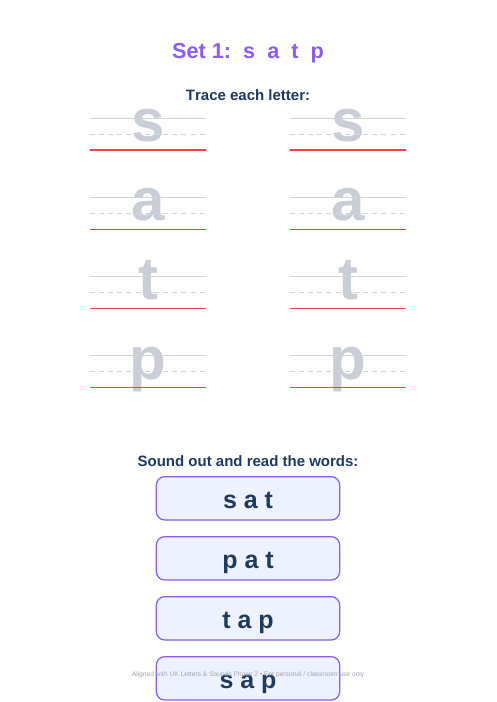
Practise this at home
Phonics Phase 2 (Letters & Sounds)
6-page printable pack · £3.99 · Buy once. Yours forever. No subscription, no renewals.
Get the packParents also read
Phase 2 Phonics Sounds in Order
Phase 2 sounds in teaching order — all five sets with pure-sound pronunciation tips, first blending words and a 5-minute daily routine.
What Is Phonics Phase 2? (UK)
Phase 2 phonics explained for UK parents: what children learn in Reception, when it's taught, the full phase timeline and 5 things to do at home.
Tricky Words Phases 2–3: Full List & Tips
All the Phase 2 and 3 tricky words from Letters & Sounds, plus practical ways to help your child learn the words that can't be sounded out.
Questions parents ask
When exactly is the phonics screening check?
In June of Year 1, during a DfE-designated week (usually the second week of June). Schools choose the day; if your child is absent, they take it when they return.
What is the pass mark for the phonics screening check?
The threshold has been 32 out of 40 every year since the check started, and the DfE confirms it after each check. Schools report whether your child met the standard, usually in the end-of-year report.
What happens if my child doesn't meet the standard?
Nothing punitive: they receive extra phonics support in Year 2 and retake the check the following June. Many children retake it and most pass second time.
Do all schools do the phonics screening check?
It is statutory for state-funded schools in England. Independent schools are not required to administer it, though some choose to.
Should I get a tutor for the phonics screening check?
Almost certainly unnecessary. Daily reading plus playful blending practice at home is the evidence-backed preparation. If the school flags a concern, work with their intervention plan rather than adding private tutoring pressure.
Will my child be nervous about the check?
Most aren't — it is designed to feel like a short reading activity with a familiar teacher, with no time limit and plenty of encouragement. If your child is anxious about new situations, let the teacher know in advance.