 LittleLearners
🔤 Phonics & Early Reading
What Is Phonics Phase 2? (UK)
The short answer
Phase 2 is the stage of the Letters and Sounds phonics programme where Reception children (age 4–5) learn letter-sounds across the autumn term and begin blending them to read simple words like 'cat', 'pin' and 'dog'. It follows Phase 1 (listening and sound games in nursery) and leads into Phase 3 digraphs such as 'sh' and 'ch'.
What your child actually learns in Phase 2
Phase 2 is where reading begins. In Phase 1 (nursery), your child played listening games — rhymes, alliteration, hearing the sounds in words. Phase 2 adds the letters: children learn the sounds in five sets and, crucially, what to do with them.
Three skills, in this order: recognising each sound, blending sounds together to read words (s-a-t becomes 'sat'), and segmenting words into sounds for early spelling (hearing 'dog' and splitting it into d-o-g). A handful of tricky words — the, to, I, no, go — joins the mix because they turn up in almost every early reading book.
By the end of the phase, most children can read simple consonant-vowel-consonant words like cat, pin and dog — and have a go at writing them too.
When it happens
Phase 2 starts in the first weeks of Reception (age 4–5) and runs through the autumn term — about six weeks, roughly one sound set per week. If your child started school in September 2026, expect Phase 2 to run until around the October half-term.
Your child's teacher will send home the current sound set — often as a sheet or on the school app. That sheet is the single most useful thing to practise: it tells you exactly which sounds are live right now.
Don't be tempted to race ahead through all five sets at home. Schools introduce them in a deliberate order, and practising the current set deeply beats skimming all of them thinly.
The full phonics journey: Phases 1 to 6
Phase 2 is one stop on a longer journey. Here is the whole map, so you can see where your child is and what's coming:
- Phase 1 (Nursery, ages 3–4): listening skills — rhyme, rhythm, alliteration, hearing sounds in spoken words. No letters yet.
- Phase 2 (Reception, autumn term): first letter-sounds in five sets, blending and segmenting CVC words, five tricky words.
- Phase 3 (Reception, spring term, about 12 weeks): the remaining letters (j, v, w, x, y, z, zz, qu) plus digraphs and trigraphs — ch, sh, th, ng, ai, ee, igh, oa, oo.
- Phase 4 (Reception, summer term): no new sounds — longer words with adjacent consonants, like tent, clap and string.
- Phase 5 (Year 1, all year): alternative spellings for the same sounds (ai, ay and a-e all say 'ay'), ending with the phonics screening check in June.
- Phase 6 (Year 2): spelling rules, prefixes and suffixes — phonics becomes spelling.
Phonics buzzwords, decoded
Teachers — and school letters — use a handful of terms that baffle most parents. Here is the whole glossary in plain English:
- Phoneme — the smallest unit of sound in a word. 'Cat' has three phonemes: c-a-t. English has 44.
- Grapheme — the letter or letters that spell a sound. 'Sh' is two letters but one grapheme.
- Blend — pushing sounds together to read: c-a-t becomes 'cat'.
- Segment — splitting a word into its sounds in order to spell it: 'dog' becomes d-o-g.
- Digraph — two letters making one sound: ch, sh, th, ng.
- Trigraph — three letters making one sound: igh (night), ear (hear).
- Tricky word — a word that can't be sounded out yet, like 'the' or 'said'. Children learn these by sight.
- CVC word — consonant-vowel-consonant: cat, pin, dog. The first words children read.
5 things you can do at home this week
You don't need to 'teach phonics' — you just need to back up what school is doing. Five things that genuinely help during Phase 2:
- Use pure sounds. Say 'mmm' not 'muh', 'sss' not 'suh'. This one change makes blending dramatically easier.
- Play oral blending games with no letters at all: 'I'm thinking of a colour: r…e…d.' Do it in the car, in the queue, at bath time.
- Practise only the school's current sound set. Ten focused minutes on this week's sounds beats an hour on all of them.
- Trace while you say. Writing or tracing a letter while saying its sound wires the learning in twice as fast — hand and voice together.
- Keep reading to them. Being read to is still the biggest driver of reading success at this age — stories build the vocabulary and love of books that phonics alone can't.
Phase 2 and the Year 1 phonics screening check
You've probably heard other parents mention 'the phonics check'. It is a short statutory assessment in June of Year 1, where children read 40 words — a mix of real and made-up words — to a teacher. It checks that phonics teaching is working.
Phase 2 is the foundation it all rests on: the blending habit your child builds now is exactly what the check measures later. There is nothing to practise for and nothing to worry about — just keep the daily blending playful and the rest follows.
If your school seems to do it differently
Most English schools now follow a DfE-validated phonics scheme — Little Wandle Letters and Sounds Revised, Read Write Inc. and Twinkl Phonics are the big three. They teach the same sounds in a very similar order, but group a few slightly differently and use their own tricky-word lists.
So if your school's 'set 2' doesn't match a list you found online, nobody is wrong — just follow your school's sequence for homework, and use guides like this one for the bigger picture.
You're already doing the most important part
Here is the reassuring truth about Phase 2: the parents who help most aren't the ones who drill flashcards for an hour — they're the ones who chat, read, rhyme and play with sounds for a few minutes every day. If you're reading this guide, you're already that parent.
When you're ready for print-and-go practice — every Phase 2 sound with tracing pages, keywords and blending words matched to the five sets — our Phase 2 phonics pack has the whole phase ready to print.
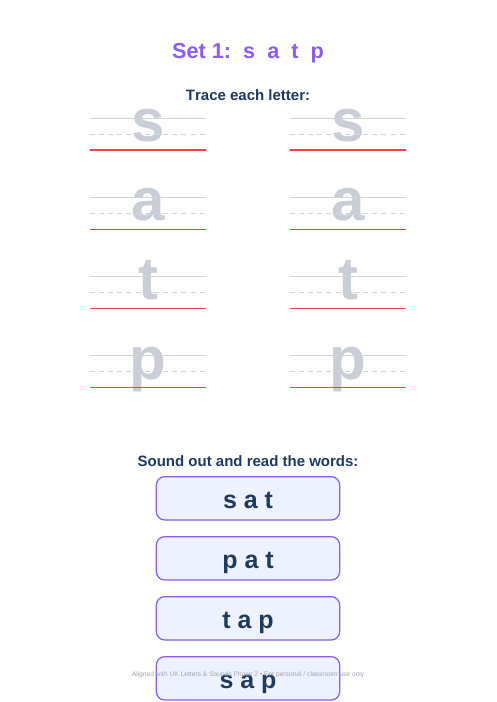
Practise this at home
Phonics Phase 2 (Letters & Sounds)
6-page printable pack · £3.99 · Buy once. Yours forever. No subscription, no renewals.
Get the packParents also read
Phase 2 Phonics Sounds in Order
Phase 2 sounds in teaching order — all five sets with pure-sound pronunciation tips, first blending words and a 5-minute daily routine.
Tricky Words Phases 2–3: Full List & Tips
All the Phase 2 and 3 tricky words from Letters & Sounds, plus practical ways to help your child learn the words that can't be sounded out.
Phonics at Home: A 10-Minute Daily Routine
A practical 10-minute daily phonics routine for parents — revisits, blending games and writing practice that mirror what UK schools do in Reception.
Questions parents ask
When is Phase 2 taught?
In the autumn term of Reception (ages 4–5), starting in the first weeks of school and lasting about six weeks — roughly one sound set per week, finishing around the October half-term.
What's the difference between Phase 2 and Phase 3?
Phase 2 teaches single-letter sounds (plus ck, ff, ll, ss) and first blending. Phase 3, in the spring term of Reception, teaches the remaining letters and digraphs — two-letter sounds like ch, sh, th and ng — plus long vowel sounds like ai, ee and igh.
Does my child need to know Phase 2 before starting school?
No. Schools teach it from scratch in Reception. The best preparation is Phase 1-style play: nursery rhymes, 'I spy', clapping out syllables, and being read to every day.
What if my child already knows all the Phase 2 sounds?
Focus on blending longer words and reading simple captions, and check with the teacher before racing into Phase 3 sounds. Deep, confident blending matters more than speed.
I learned to read differently — how can I help?
The one thing to relearn is pure sounds: 'mmm' not 'muh', 'sss' not 'suh'. Everything else — reading together, rhyming games, chatting — works exactly as it always has.
Will my child be tested on Phase 2?
Not formally. Teachers assess phonics continuously through daily practice — listening to children read and blend — and use what they hear to decide who needs extra support. The first formal check is the Year 1 phonics screening in June, a year and a half later.