 LittleLearners
Year 1 & Year 2 Spelling Lists: Every Pattern, Explained
The spelling patterns your child learns in Year 1 and Year 2 — with the example words schools use, a free printable practice pack, and the simple routines that make spellings stick. No sign-up, no cost.
10 pages · Year 1 & Year 2 pattern lists · Look–Cover–Write–Check practice · Homophones · Dictation sentences
Two kinds of spelling in Key Stage 1
KS1 spelling comes in two flavours. Most words follow patterns — rules a child can learn and reuse, like doubling the last letter in hopping or changing y to i in babies. Those patterns are what this page covers.
The other flavour is the common exception words — words like said, because and people that break the rules and simply have to be memorised. They have their own page here: Year 1 & Year 2 common exception words. Most children need a bit of both, in small weekly doses.
Year 1 spelling patterns
Year 1 spelling grows straight out of phonics. Children learn that sounds have favourite spellings — and when to use them:
| Spelling pattern | Example words |
|---|---|
| ff, ll, ss, zz, ck | off, well, miss, buzz, back |
| n before k | bank, think, honk, sunk |
| -tch | catch, fetch, kitchen, notch, hutch |
| Words ending in -ve | have, live, give |
| Adding -s and -es | cats, dogs, rocks, catches |
| Adding -ing, -ed, -er | hunting, hunted, hunter, jumping |
| Adding -er and -est | grander, grandest, quicker, quickest |
| Prefix un- | unhappy, undo, unload, unfair, unlock |
| Compound words | football, playground, bedroom, blackberry |
| ai, oi, ay, oy | rain, train, oil, coin, day, play, boy, toy |
The golden rule for most Year 1 patterns: they appear straight after a short vowel. That's why back ends in -ck and catch needs the -tch, while milk and beach don't.
Year 2 spelling patterns
Year 2 adds silent letters, trickier endings and the first real "rules with exceptions". This is also when homophones (there/their, to/too/two) and contractions (can't, didn't) arrive:
| Spelling pattern | Example words |
|---|---|
| -dge and -ge | badge, edge, bridge, fudge, age, huge, change |
| c before e, i and y | race, ice, cell, city, fancy |
| kn and gn (silent letters) | knock, know, knee, gnat, gnaw |
| wr (silent w) | write, written, wrote, wrong, wrap |
| -le, -el, -al, -il endings | apple, bottle, camel, tunnel, metal, animal, pencil |
| Words ending in -y | cry, fly, dry, try, reply, July |
| Changing y to i, add -es | flies, tries, babies, carries |
| Drop the -e, add -ing | hiking, hiked, nicer, nicest, shiny |
| Double the last letter | patting, patted, humming, dropping, runner |
| a before l and ll | all, ball, call, walk, talk, always |
Two Year 2 rules cause the most tears at homework time. "Drop the e" (hope → hoping) and "double the letter" (hop → hopping) — and yes, children mix them up constantly, because the words look so similar. Practising the pair side by side is exactly what fixes it.
How to practise spellings at home (without the battle)
- Little and often wins. Five to ten words a week, revisited for a few minutes daily, beats a Sunday-night cram every time.
- Look, Cover, Write, Check. The method schools use: look at the word and say it, cover it, write it from memory, then check letter by letter. Our free pack has ready-made practice grids.
- Spot the pattern, not just the word. If this week's list is full of -le words, hunt for them together in a story book. Patterns stick; isolated lists don't.
- Try dictation. Read a short sentence aloud and let your child write it. It tests spelling inside real writing — which is exactly what teachers assess.
- Wrong is data, not failure. If bridge comes back as "brige", the -dge pattern is the lesson. Praise the attempt, fix the pattern.
More free spelling & phonics practice
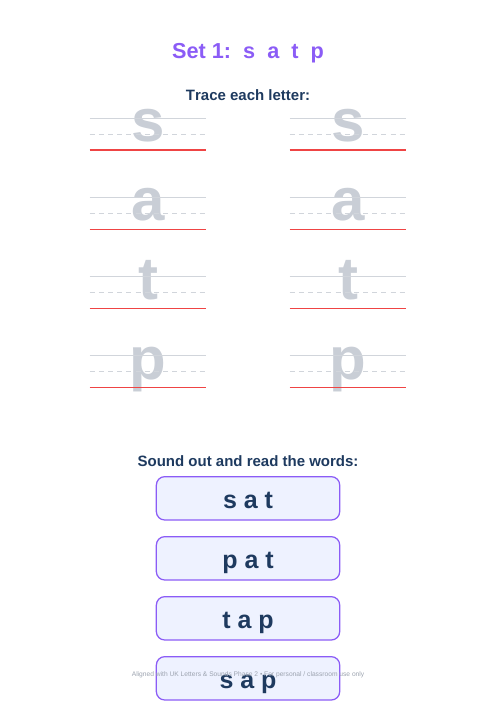
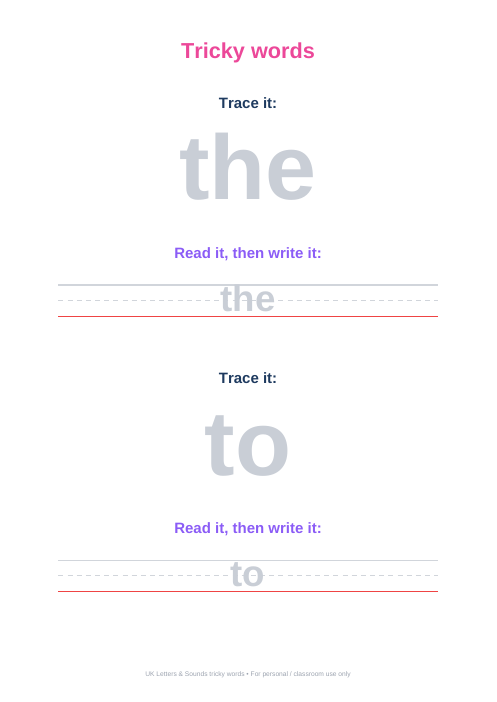
Questions parents ask
Where do these spelling lists come from?
From the National Curriculum's spelling appendix — the same patterns and example words schools plan from. Each school sequences them slightly differently, so always follow your child's weekly list first; use these lists to understand the pattern behind it.
How many spellings should my child learn each week?
Most schools send home 5–10 words a week in KS1. If there's no school list, pick one pattern from the tables above and learn 5 words that use it.
My child spells phonetically — every word sounds right but looks wrong. Is that a problem?
It's a normal stage, and actually a good sign: it means phonics is working. The next step is exactly these patterns — learning which spelling of a sound a word uses. Little and often is the fix.
What's the difference between these and the common exception words?
Pattern words play by the rules on this page. Exception words don't — they contain a part you just have to remember, like the 'ai' in said. Our common exception words page covers those, year by year.
Should we practise handwriting at the same time?
Not during spelling practice. Mixing the two makes both harder. Spelling sessions are for patterns; neat writing has its own time.