 LittleLearners
🔤 Phonics & Early Reading
Phonics at Home: A 10-Minute Daily Routine
The short answer
Ten minutes a day is enough: 2 minutes revisiting known sounds with flashcards, 4 minutes blending games (point, sweep, read), 2 minutes writing or tracing the newest sound, and 2 minutes reading a decodable book or playing a sound game. Keep it daily, playful and pressure-free — stop while it's still fun.
Why ten minutes beats an hour on Saturday
Young brains learn through spaced repetition — small, frequent encounters with the same sounds. A child who practises ten minutes daily sees each sound roughly seventy times a week; a child who does an hour on Saturday sees it once, then forgets it by Wednesday.
Schools know this: phonics is taught in short daily sessions, not weekly marathons. Your home routine works best when it copies that rhythm. Ten focused minutes with you, one-to-one, is genuinely more powerful than a longer session — attention spans at four and five are short, and that's biology, not behaviour.
Before you start: find out what school is teaching
The single biggest mistake parents make is practising the wrong sounds. If school is on Set 2 (i, n, m, d) and you're drilling Set 4 at home, your child gets confusion instead of confidence.
Ask the teacher — or check the reading diary, book bag letters or school app — for the current sound set. Most schools send sounds home as they're taught. Practise those sounds and only those sounds, plus quick revisits of earlier sets.
If you want the full picture of the Phase 2 sequence for your own understanding, our Phase 2 sounds guide lays out all five sets with pronunciation tips. For the daily routine itself, though, your school's current set is the whole syllabus.
The routine: 2 – 4 – 2 – 2
Here is the ten-minute shape. It fits between tea and bath, or in the morning before school — whenever your child is most alert:
- 2 minutes — Revisit: flashcards of sounds already learned. Show each card, your child says the sound purely. Shuffle the order so they're reading, not reciting. Quick and snappy.
- 4 minutes — Blend: five or six words made only from the current sound set. Write them large or use magnetic letters. Point to each sound, sweep under the word, read it a little faster each time. Swap one letter to make a new word (pin → tin) and watch them read it.
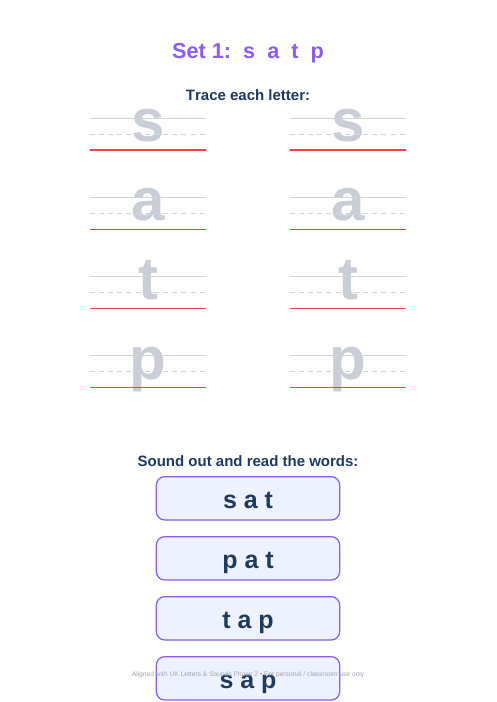
- 2 minutes — Write: trace or write the newest sound while saying it. Hand and voice together cements the memory. Big paper, chunky pencil, no pressure on neatness.
- 2 minutes — Read or play: a decodable book matched to the current phase, or a quick sound game (see below). End on something enjoyable.
Blending games that don't feel like lessons
The four blending minutes are where the magic happens — and they don't have to look like school:
- Robot talk: speak like a robot ('bring me the c-u-p') and your child blends to work out what you mean. Then they get to be the robot.
- I spy, phonics edition: 'I spy something beginning with mmm' — pure sounds only.
- Shopping list: write a list of three CVC words (real shopping or pretend). Your child blends each one to 'buy' it.
- Magnetic letter swaps: build 'sat', blend it, swap the s for a p. New word, instant success, huge grin.
- Silly sentence building: blend two words, then use them in the silliest sentence you can invent together.
Segmenting: the writing side of phonics
Blending is for reading (pushing sounds together). Segmenting is for spelling (pulling them apart) — and it needs practise too. The classic tool is 'phoneme fingers': say a word slowly and put up a finger for each sound. 'Dog' gets three fingers: d-o-g.
Try it with labelling: your child draws a picture, you help them segment the word, and they write the sounds they hear. 'Cat' might come out as 'ct' — that's brilliant, not wrong. They're hearing sounds and representing them, which is exactly what segmenting is.
Don't correct every invented spelling at this stage. The goal is the habit of listening for sounds, not perfect orthography at age four.
What to do when they get stuck
Every child hits walls. The wrong response is drilling the same card louder; the right responses are:
- Step back, not forward: if blending 'stamp' fails, drop to 'sat'. Success rebuilds confidence; struggle on the same word just rehearses failure.
- Go oral: put the letters away entirely and play blending games by ear ('I'm thinking of an animal: d-o-g'). When it clicks by ear, the print follows.
- Model, don't correct: instead of 'no, that's wrong', just say the word the pure way yourself and let them copy. Correction creates tension; modelling creates learning.
- Check the basics: are they adding 'uh' to sounds ('suh-ah-tuh')? Are they tired, hungry, or done for the day? Some stuck moments are really just tired moments.
- Leave it: a sound that won't stick on Tuesday often arrives on its own by Friday. The brain consolidates overnight — and over weeks.
Reading books at home: two kinds of reading
Keep two reading streams separate. Decodable books — matched to your child's current phase, where nearly every word can be sounded out — are for practise. Your child reads these to you, using their phonics.
Bedtime stories are different: rich picture books, read by you, far above your child's decoding level. This is where vocabulary, story sense and love of reading grow. Never turn a bedtime story into a phonics test — that's how children learn to dread books.
If school sends decodable books home, those two minutes of the routine are their moment. If not, any simple book from the current phase works — the school can usually suggest titles.
A weekly shape that keeps it fresh
Same ten minutes, slightly different flavour each day, keeps the routine from going stale: Mondays for new sounds, Tuesdays for blending games, Wednesdays for writing, Thursdays for silly sentences, Fridays for a 'show off what you know' session for a grandparent or teddy bear audience.
Weekends are optional. Five days a week of this routine puts your child ahead of nearly every alternative — and if you miss a day, the routine is still there tomorrow. Consistency over months beats intensity over days.
If you'd like print-and-go pages for the writing minutes — every Phase 2 sound with tracing and keyword pictures — our Phase 2 pack is built for exactly this routine, and the alphabet tracing pack gives little hands the letter-formation practise to match.
Practise this at home
Phonics Phase 2 (Letters & Sounds)
6-page printable pack · £3.99 · Buy once. Yours forever. No subscription, no renewals.
Get the packParents also read
Phase 2 Phonics Sounds in Order
Phase 2 sounds in teaching order — all five sets with pure-sound pronunciation tips, first blending words and a 5-minute daily routine.
What Is Phonics Phase 2? (UK)
Phase 2 phonics explained for UK parents: what children learn in Reception, when it's taught, the full phase timeline and 5 things to do at home.
Tricky Words Phases 2–3: Full List & Tips
All the Phase 2 and 3 tricky words from Letters & Sounds, plus practical ways to help your child learn the words that can't be sounded out.
Questions parents ask
Is ten minutes really enough?
Yes. Schools teach phonics in 20–30 minute whole-class sessions, but one-to-one ten minutes with a parent is more focused than any classroom slot. What matters is daily frequency, not session length.
What if my child resists or won't sit still?
Offer choice ('robot talk or magnetic letters?'), pick a high-energy moment, and keep it game-shaped. Some days won't happen — that's fine. Forcing a resistant four-year-old teaches them that phonics is miserable, which is worse than missing a day.
Should we do it at the same time every day?
A consistent slot helps it become habit — after breakfast, before bath, whatever fits your family. But the routine matters more than the clock: same shape, same games, whenever energy is good.
My school uses Little Wandle / Read Write Inc. — does this routine still apply?
Completely. The routine is scheme-agnostic: revisit, blend, write, read. Just use your school's current sound set and order rather than any generic list, and you'll be reinforcing exactly what the classroom teaches.
Can an older sibling help with phonics practice?
Yes, and it's often brilliant — siblings model sounds naturally and younger children try harder to impress them. Just make sure the sibling says sounds purely too (no 'suh'), and keep you in the loop on which set they're on.
Are phonics apps useful, or should it all be physical?
A few minutes on a good app can supplement, but physical practice — cards, magnetic letters, writing — builds stronger connections at this age. This routine deliberately keeps screens out; ten minutes of real interaction beats thirty of tapping.