 LittleLearners
🔤 Phonics & Early Reading
Phase 2 Phonics Sounds in Order
The short answer
Phase 2 teaches five sound sets in order: Set 1 – s, a, t, p; Set 2 – i, n, m, d; Set 3 – g, o, c, k; Set 4 – ck, e, u, r; Set 5 – h, b, f, ff, l, ll, ss. Say sounds purely ('sss', not 'suh') so your child blends them into words like sat, pin and tap.
The five Phase 2 sets, in teaching order
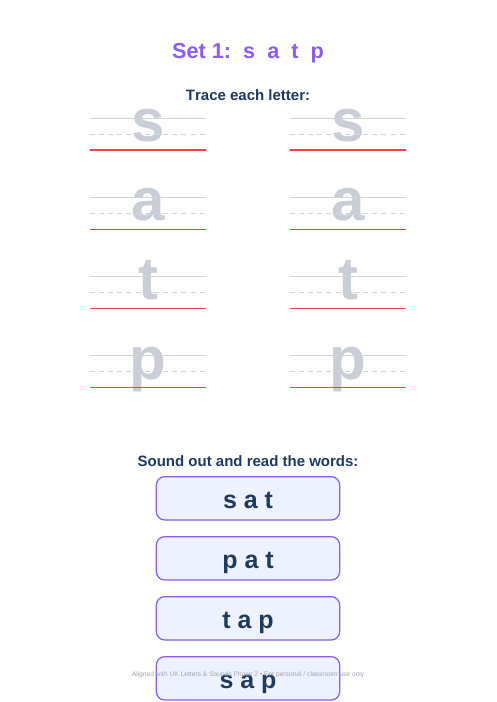
Schools teach the sounds in a fixed order, and the order is clever: the first four sounds alone — s, a, t, p — are enough to build real words (sat, pat, tap, at, a). That means children start reading within days, which keeps them motivated.
The usual pace is one set per week, so the whole phase takes about six weeks including a revision week. It runs in the autumn term of Reception, starting in the first weeks of school.
- Set 1: s, a, t, p — first words to try: sat, pat, tap, at, a
- Set 2: i, n, m, d — first words to try: pin, mat, sit, nip, dip, in
- Set 3: g, o, c, k — first words to try: got, cat, kit, cot, dog
- Set 4: ck, e, u, r — first words to try: sock, pen, run, red, duck (ck only ever ends a word)
- Set 5: h, b, f, ff, l, ll, ss — first words to try: hat, fun, bell, hiss, puff
Say it purely: the mistake almost every parent makes
This is the single most useful thing in this guide. When adults sound out letters, we almost always add an extra 'uh': 'suh', 'muh', 'tuh'. Do that in front of your child and 'sat' becomes 'suh-ah-tuh' — three extra sounds that make blending nearly impossible.
Instead, say each sound purely. Some sounds stretch: sss, mmm, nnn, fff, lll, rrr. Let them hiss and hum for as long as you like. The rest are short, bouncy sounds — say them as crisply as you can: t, p, d, g, c, k, b, h. Think of them as tiny taps, not 'tuh' and 'puh'.
Vowels are short and quick: a as in apple, e as in egg, i as in insect, o as in orange, u as in umbrella.
If your child is already saying 'cuh-ah-tuh', don't correct them mid-word — just model it back the pure way, sweeping your finger under the letters: 'c-a-t… cat'. They will copy you within days.
- s — hiss: ssss (not 'suh')
- a — a as in apple (not 'ay')
- t — tiny tap: t (not 'tuh')
- p — lip pop: p (not 'puh')
- i — i as in insect
- n — hum: nnnn (not 'nuh')
- m — hum: mmmm (not 'muh')
- d — tap: d (not 'duh')
- g — g as in go (not 'guh')
- o — o as in orange
- c, k, ck — short 'k' at the back of the throat (not 'kuh'); ck only ever ends a word
- e — e as in egg
- u — u as in umbrella
- r — growl: rrr (not 'ruh'; rolled or smooth, both are fine)
- h — breathy h (not 'huh')
- b — tap: b (not 'buh')
- f, ff — blow: ffff (not 'fuh')
- l, ll — sing: llll (not 'luh')
A picture keyword for every sound
A keyword picture gives each sound a hook in your child's memory — this is why classrooms have a snake on the wall for 's'. When your child hesitates, the picture does the reminding, not you.
You don't need anything fancy: draw them, cut them from magazines, or just name them in a game ('I spy something that starts with mmm').
- s — snake (ssss), a — apple (a-a-apple), t — tiger (t-t-tiger), p — popcorn (p-p-pop)
- i — insect (i-i-insect), n — nest (nnn), m — moon (mmm), d — dog (d-d-dog)
- g — goat (g-g-goat), o — orange (o-o-orange), c — cat (c-c-cat), k — kite (k-k-kite)
- ck — duck (hear it at the end: du-ck), e — egg (e-e-egg), u — umbrella (u-u-up), r — rabbit (rrr)
- h — hat (h-h-hat), b — ball (b-b-ball), f — fish (ffff), l — lion (llll)
- ff, ll and ss are simply double spellings of f, l and s — same sound, same keyword
Blending: turning sounds into first words
Blending is the whole point of Phase 2: pushing sounds together to read. s-a-t becomes 'sat'. It looks like magic the first time a child does it, but it is a teachable skill.
Start with words made only from sounds your child already knows — there is no point handing them 'ship' when they haven't met 'sh'. Point to each letter as they say its sound, then sweep your finger under the whole word and say it a little faster each time: 's…a…t, sat'.
Magnetic letters on the fridge work brilliantly: build 'pin', let them blend it, then swap the p for a t and watch their face when they read 'tin'.
Keep it playful and stop before frustration sets in. Five successful blends beat twenty tearful ones.
The tricky words of Phase 2
Most Phase 2 words can be sounded out — but a few can't, and children meet them constantly in early books. The original Letters and Sounds programme lists five tricky words for Phase 2: the, to, I, no, go.
You may see six on some lists, with 'into' added. That is not a mistake — some phonics schemes teach it here too. If your school's list has six, learn six.
Because these words break the sounding-out rules, children learn them by sight: look at the word, say it, cover it, write it, check it. A 'tricky word hunt' — sticky notes hidden around the house — turns the dullest part of phonics into a game.
A 5-minute-a-day routine that actually works
Short and daily beats long and occasional — every teacher will tell you this. Here is a routine that fits between tea and bath:
- 2 minutes: flashcards — show each known sound and your child says it purely. Shuffle the order so they are reading, not reciting.
- 2 minutes: blend five words from the current set. Point, sweep, read.
- 1 minute: write or trace the newest sound while saying it — hand and voice together.
- Stop while it is still fun. Tomorrow the sounds will be stronger for it.
What if my school's order looks slightly different?
The order above is the classic DfE Letters and Sounds sequence from 2007, and it is what most parent guides show. But most English schools now teach a DfE-validated phonics scheme — Little Wandle, Read Write Inc. or Twinkl Phonics — and these group a few sounds slightly differently (the double letters ff, ll and ss are often taught in their own groups, for example).
The sounds themselves are identical; only the grouping changes. For homework, always follow your school's order. Use this guide to understand what is happening and how to help.
Keep it short, keep it fun, keep it daily
Phase 2 lasts about six weeks, but the habits it builds — pure sounds, daily practice, blending with confidence — carry your child through every phase that follows. You don't need special training to help; you just need the right order, the right sounds, and five minutes a day.
If you would like the whole phase as print-and-go practice pages — every sound with tracing, keywords and blending words — our Phase 2 pack covers all five sets in pages you can print as many times as you like.
Practise this at home
Phonics Phase 2 (Letters & Sounds)
6-page printable pack · £3.99 · Buy once. Yours forever. No subscription, no renewals.
Get the packParents also read
What Is Phonics Phase 2? (UK)
Phase 2 phonics explained for UK parents: what children learn in Reception, when it's taught, the full phase timeline and 5 things to do at home.
Tricky Words Phases 2–3: Full List & Tips
All the Phase 2 and 3 tricky words from Letters & Sounds, plus practical ways to help your child learn the words that can't be sounded out.
Phonics at Home: A 10-Minute Daily Routine
A practical 10-minute daily phonics routine for parents — revisits, blending games and writing practice that mirror what UK schools do in Reception.
Questions parents ask
How long does Phase 2 take?
About six weeks — roughly one sound set per week — taught in the autumn term of Reception (ages 4–5). Schools usually start in the first weeks of September and finish around the October half-term.
Should I teach letter names like 'ay, bee, cee' as well?
Not during Phase 2. Letter names come later, and mixing them in now confuses blending. If your child already knows them, that's fine — just use sounds ('mmm') when you're practising phonics.
What if my child just can't blend?
Step back from letters entirely and play oral blending games: 'I'm thinking of an animal: d…o…g.' Clap the sounds, stretch them, be silly with it. Once blending clicks by ear, the printed letters follow quickly.
How many tricky words are there in Phase 2?
Five in the original Letters and Sounds programme: the, to, I, no, go. Some schools and schemes add 'into', making six. Learn whichever list your child's school sends home.
Is the Phase 2 order the same in every UK school?
The classic DfE order on this page is the most widely shown, but schools using Little Wandle, Read Write Inc. or Twinkl Phonics group a few sounds slightly differently. The sounds are the same either way — follow your school's order for homework.
When should we start practising at home?
As soon as the school sends the first sound set home — usually within the first couple of weeks of Reception. Before that, Phase 1-style listening games (rhymes, 'I spy', clapping syllables) are the perfect preparation.