 LittleLearners
✏️ Writing & Fine Motor Skills
When Do Children Learn Capital Letters? (UK Parent's Guide)
The short answer
In the UK, most children start writing capital letters in Reception (ages 4-5), beginning with the first letter of their own name. By the end of Year 1 (ages 5-6), they use capitals for names, the pronoun 'I' and the start of sentences. Schools teach lowercase letters first because they appear far more often in reading and writing.
The short answer: ages and stages
There is no single birthday when capital letters click — it happens in stages, and every child moves through them at their own pace. But UK classrooms follow a fairly consistent order, and knowing it helps you pitch your help at the right level instead of pushing too early or waiting too long.
Roughly speaking: at 3-4, children notice capitals on signs, book covers and toy packaging, and many can name a few — usually the letters in their own name. At 4-5 (Reception), they start writing the capital first letter of their name and copying other capitals. At 5-6 (Year 1), they learn the rules: capitals for names, for the word 'I', and at the start of sentences.
- Age 3-4: notices capitals in the environment — signs, names, book titles.
- Age 4-5 (Reception): writes the capital first letter of their name; copies other capitals.
- Age 5-6 (Year 1): uses capitals for names, 'I' and sentence starts — the three core rules.
- Age 6-7 (Year 2): applies capitals consistently in independent writing, including days, months and place names.
Why schools teach lowercase first
This surprises many parents: in the UK, children learn lowercase letters before capitals. It feels backwards — capitals look simpler, with their big straight lines — but there is a solid reason. Around 95% of the letters children read in books are lowercase, so recognising and writing them matters far more for early reading.
There is a second reason. Lowercase letters are what children write most, so schools secure those first and add capitals as a smaller, separate job. Trying to teach both cases at once doubles the memory load for little gain. That said, capitals are genuinely easier to form — fewer curves, bigger movements — which is why the first capital (usually in their name) often arrives before lowercase writing is secure.
- Lowercase first: they dominate early reading books, so they earn priority.
- Capitals second: a smaller set of rules, taught once lowercase is underway.
- The exception: the capital first letter of their name, which most children learn early because it matters to them personally.
The order children actually learn capitals
Capitals do not arrive all at once — they arrive in a predictable sequence, and each step builds on the last. The first capital is almost always the first letter of the child's own name. It is the most meaningful letter they know, so it gets the most practice, and Reception teachers lean into this heavily.
Next come capitals at the start of sentences, taught alongside full stops in Year 1 — the two are a natural pair. Then the pronoun 'I', which is always a capital in English (a rule children find delightfully simple). Proper nouns follow: names of people, places, days and months. Random mid-sentence capitals — the classic 'My Dog is Called REX' phase — are a normal stepping stone, not a failure. It shows the child knows capitals matter and is over-applying the rule while they sort out exactly where.
- First: the capital at the start of their own name (Reception).
- Then: capitals at the start of sentences, paired with full stops (Year 1).
- Then: the pronoun 'I' — always capital, no exceptions.
- Then: proper nouns — people, places, days of the week, months.
- The 'everything in capitals' phase in between is normal and temporary.
Signs your child is ready
You do not need to wait for school to give permission — but pushing capitals before a child is ready just creates frustration. The readiness signs are the same ones teachers look for. Can they hold a pencil with a reasonable tripod grip, or are they still fist-gripping? A fist grip means the hand muscles are not ready for controlled letter shapes yet, and more colouring and playdough will help more than any worksheet.
Look for interest, too. A child who points out letters on signs, asks 'what does that say?' or tries to write their name unprompted is telling you they are ready. And check the basics: if they can draw circles, lines and crosses with some control, they have the strokes needed for most capitals — which are built from straight lines and simple curves.
- Holds a pencil with fingers (tripod grip emerging), not a full fist.
- Shows interest: points at letters, asks about signs, tries to write their name.
- Can draw lines, circles and crosses with reasonable control.
- Recognises at least a few capital letters by sight, usually from their name.
How to help at home
Keep it short, keep it playful, and follow the school's order: name first, then sentence starts, then 'I'. Start with the capital first letter of their name — write it big, let them trace over your writing with a finger, then a crayon, then try it underneath. Names are the best first word because the motivation is built in.
Play capital letter spotter when you are out: who can find a capital letter on that shop sign? On that number plate? This builds recognition without any sitting down. When they are ready to write, use proper handwriting lines — the lines teach size and placement, which is half of what makes capitals look right. And say the formation out loud as they write: 'down, across' for T, 'down, round, round' for B. Hearing the steps while doing them wires the sequence in far faster than silent copying.
One habit to avoid: do not let them write their whole name in capitals once they can. It is a common phase and it feels neat to them, but it stores the wrong pattern. Gently insist on capital-first-letter-only from the start — it is much harder to unlearn later.
- Start with the capital first letter of their name — trace over yours, then copy.
- Play capital-letter spotter on signs and number plates when out and about.
- Use proper handwriting lines so capitals learn their size and placement.
- Say the formation steps aloud: 'down, across' for T, 'down, round, round' for B.
- Insist on capital-first-letter-only for names from day one — whole-name capitals are hard to unlearn.
Common mistakes (and why they are normal)
Almost every child goes through an EVERYTHING IN CAPITALS phase, usually in Reception or early Year 1. It looks alarming on the page, but it is actually a good sign: the child has grasped that capitals are important and is applying the idea enthusiastically while the precise rules catch up. Correct gently — 'capitals are for the start, remember?' — and it fades within months.
Reversed capitals (like a backwards S or J) are also normal up to around age 7. Young children's brains are still sorting out left-right orientation, and it has nothing to do with intelligence. The same goes for mixed sizes — a huge A next to a tiny B. Consistent sizing comes with handwriting-line practice, not with telling them to 'write neatly'. If reversals persist heavily past age 7-8, mention it to the teacher, but before that it is developmental, not a problem.
- Everything in capitals: normal enthusiasm — the rules catch up within months.
- Backwards S, J or Z: normal left-right sorting, usually gone by age 7.
- Wildly mixed sizes: fixed by handwriting lines, not by nagging about neatness.
- Writing their name all in capitals: break this habit early — it is the one worth correcting firmly.
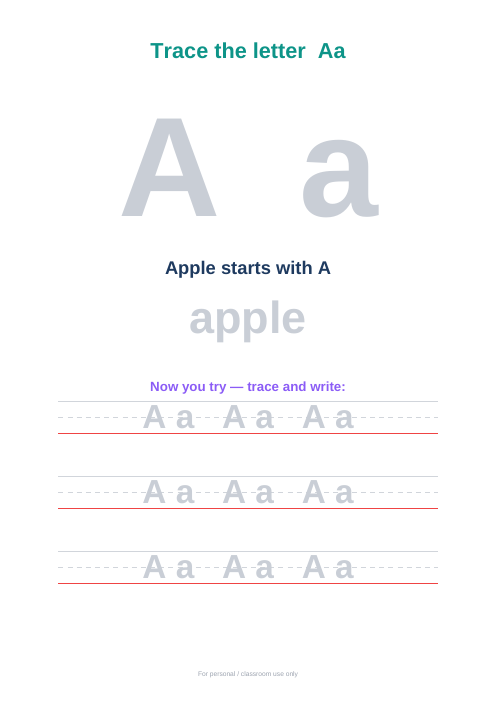
Practise this at home
Alphabet Tracing A–Z
27-page printable pack · FREE · Free forever. Download, print, enjoy — no sign-up, no payment.
Get the packParents also read
Pre-Writing Skills Before Letters
Before letter tracing: the pre-writing strokes — lines, curves, zigzags and shapes — that build the hand control children need for writing.
Pencil Grip Guide for Parents: Ages 3–6
The tripod grip explained for parents: how pencil grip develops, what to model, practical exercises — and what not to correct too early.
Scissor Skills Progression (Ages 3–5)
The scissor skills progression: snipping, straight lines, zigzags, curves and shapes — with safety basics and left-handed tips for parents.
Line Tracing: The Full Progression
The line tracing progression, level by level: finger tracing to thin lines, mazes and shapes — when to move up, and how to know your child is ready.
Easy Mazes for Preschoolers
Why mazes are secretly brilliant for little hands — pencil control, concentration and problem-solving — plus when to start, how to progress, and the honest limits.
Colour by Number for 4 Year Olds
Why colour by number is more than colouring — number recognition, concentration and fine motor control — plus the right age to start and how to keep it fun.
Free printable packs for this topic
Questions parents ask
At what age should my child write capital letters?
Most UK children write their first capital (usually in their name) in Reception at ages 4-5, and use capitals correctly for names, 'I' and sentence starts by the end of Year 1 (ages 5-6).
Should I teach uppercase or lowercase letters first?
Lowercase first — UK schools do this because lowercase letters dominate early reading books. Teach the capital first letter of their name alongside, then add other capitals once lowercase is underway.
Why does my child write everything in capital letters?
It is a normal phase. They have understood that capitals matter and are over-applying the rule. Gently remind them capitals go at the start of sentences and names, and the phase passes within months.
When do UK schools teach capital letters?
Reception introduces the capital first letter of names; Year 1 teaches the rules properly — capitals for names, the pronoun 'I' and sentence starts, alongside full stops.
How can I help my child practise capital letters at home?
Start with their name, play capital-letter spotter on signs, use proper handwriting lines, and say formation steps aloud ('down, across' for T). Keep sessions short and playful.
My child writes letters backwards. Is this normal?
Yes, up to around age 7. Reversed letters like backwards S or J are a normal part of learning left-right orientation, not a sign of a problem. Mention it to the teacher only if it persists heavily past age 7-8.