 LittleLearners
✏️ Writing & Fine Motor Skills
Pre-Writing Skills Before Letters
The short answer
Children need pre-writing strokes before letters: vertical and horizontal lines, circles, crosses, squares, zigzags and waves. Practise them big and playful — chalk, paint, finger tracing — and only move to letter tracing when the strokes flow easily and your child can copy shapes with reasonable control.
Why tracing letters too early backfires
It's tempting to hand a three-year-old an alphabet workbook — it feels like a head start. But letters are complex shapes built from simpler strokes, and a hand that can't yet draw a confident circle will produce wobbly, frustrating 'a's and 'o's.
Think of it like learning an instrument: nobody starts with the concerto. Scales first — then the music comes easily.
Worse, struggling with letters too early teaches children that writing is hard and miserable, and can cement awkward grips and bad stroke habits that take years to undo. The genuinely faster route is mastering the strokes first, so letters feel easy when they arrive.
It helps to know what comes before strokes, too. Children move through mark-making stages: disordered scribbling (marks for pure pleasure — respond with delight and lots of paper), controlled scribbling (watching their hand, repeating motions), and named scribbling ('it's a dog!' — marks now stand for something, the birth of the symbolic thinking writing needs). Only then do recognisable shapes emerge. Rushing a child past the scribble stages is like skipping foundations to build the roof faster.
The pre-writing strokes, in order
Children develop these strokes in a roughly predictable sequence. There's no need to teach them formally — just notice the order and offer the next one through play:
- Vertical line (|) — around age 2; the first controlled stroke
- Horizontal line (—) — around 2½
- Circle (○) — around 3; the gateway to o, a, d, g, q
- Cross (+) — around 3½–4; needs stopping and changing direction
- Square (□) — around 4; four planned strokes in sequence
- Diagonal lines (/ \) and triangle (△) — around 4½–5
- Zigzags and waves — around 5; the control needed for w, v, z
How to practise: big before small
The golden rule: big movements before small ones. Shoulder and arm control develops before finger control, so start huge:
- Pavement chalk: giant circles, wavy roads for toy cars, hopscotch lines
- Water painting: a big brush and a bucket on the patio or fence — magical and mess-free
- Sand, shaving foam or flour trays: finger-drawn strokes, endlessly re-doable
- Then chunky crayons on big paper — and only later, pencils on worksheets
Strength before skill: the muscles writing needs
Strokes need strength behind them. The small hand muscles develop through play, not practise sheets:
- Playdough: squeezing, rolling, pinching — the single best hand-strengthener
- Tweezers and tongs: moving pom-poms, pasta or cotton balls between bowls
- Clothes pegs: pegging cards to a line builds the exact pinch writing uses
- Threading: beads, pasta tubes on string, lacing cards
- Spray bottles and pipettes: brilliant for water play and finger strength
From strokes to letters: knowing when they're ready
Look for these signs rather than a birthday: your child copies circles, crosses and squares with reasonable control; they can trace a wavy line without veering wildly; they show interest in letters (pointing them out, asking 'what does that say?'); and they can sit with a focused activity for five to ten minutes.
When those line up, start with the letters built from strokes they've mastered — c, o, a are circles; l, t, i are lines. Letters like s, k and z, which need diagonals and direction changes, come later. There's no prize for alphabetical order.
A practical tip for the first letters: start with the ones in your child's name. Nothing motivates like writing something that belongs to you — a child who can write 'MUM' or the first letter of their name will practise voluntarily in a way no worksheet ever achieves. Capitals first is fine at this stage; the capital letters are mostly straight lines and far more forgiving than their lowercase cousins.
What to avoid
Workbooks designed for older children, with small lines and dense pages — they demand precision little hands don't have yet. Constant grip correction during play — it turns fun into a lesson (see our pencil grip guide for when correction actually helps). Long sessions — five playful minutes beats twenty forced ones. And comparing with other children: the normal range for these skills spans more than a year in either direction.
Also avoid 'tracing over your hand' — guiding your child's hand through letters for them. It feels helpful, but the child isn't practising the motor planning at all; they're a passenger. If they can't form the stroke alone, the stroke is too hard — drop back to an easier one and let them own it.
A week of pre-writing play
You don't need a curriculum — but if you like a shape to the week, try this. Ten minutes a day, all play. Repeat favourite days whenever your child asks: at this age, repetition is the learning, not a failure of variety.
- Monday: chalk circles on the pavement — how big? how small?
- Tuesday: playdough snakes, then cut them with (child-safe) scissors
- Wednesday: shaving-foam zigzags on a tray
- Thursday: peg games — pegging coloured cards in patterns
- Friday: water-paint wavy roads for toy cars on the fence
When letters come next
Pre-writing isn't a delay — it's the foundation that makes letter formation quick and tear-free when the time comes. Most children are ready for real letter tracing somewhere between four and five, and the ones who practised strokes first take to it noticeably faster.
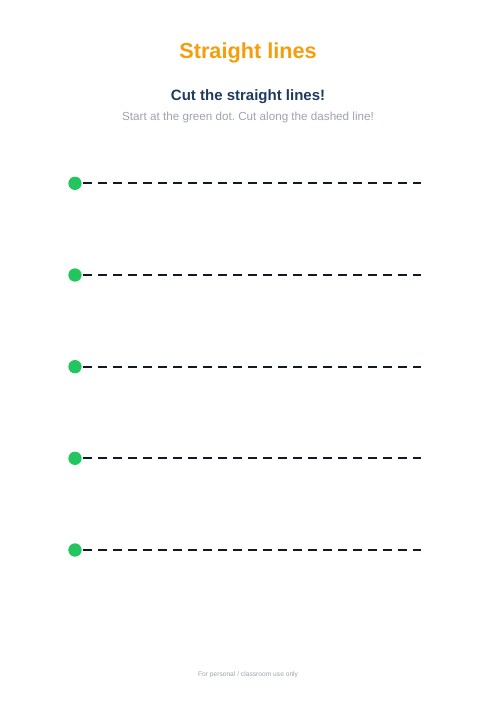
When you're ready, our scissor skills pack continues the fine-motor story with progressive cutting lines, and the alphabet tracing pack picks up exactly where the strokes leave off — every letter with UK handwriting lines, ready to print as many times as you like.
Practise this at home
Scissor Skills: Cut Along the Lines
9-page printable pack · £3.99 · Buy once. Yours forever. No subscription, no renewals.
Get the packParents also read
Pencil Grip Guide for Parents: Ages 3–6
The tripod grip explained for parents: how pencil grip develops, what to model, practical exercises — and what not to correct too early.
Scissor Skills Progression (Ages 3–5)
The scissor skills progression: snipping, straight lines, zigzags, curves and shapes — with safety basics and left-handed tips for parents.
Line Tracing: The Full Progression
The line tracing progression, level by level: finger tracing to thin lines, mazes and shapes — when to move up, and how to know your child is ready.
Questions parents ask
What age should pre-writing practice start?
Playful mark-making from around 2 — chalk, paint, fingers in sand. More structured stroke practice fits naturally around 3–4. There's no need to 'teach' strokes before a child is interested in making marks.
My child only scribbles — is that okay?
Completely. Scribbling is the first stage of mark-making and it matters: it teaches that marks carry meaning. Controlled strokes emerge from scribbling naturally, usually between 2 and 3. Celebrate the scribbles.
How long before we try proper letters?
Think weeks and months, not days. When circles, crosses and squares are confident and your child is curious about letters, they're ready. Rushing this step is the single most common cause of writing frustration at four.
Should I correct their pencil grip yet?
Model a good grip and offer short crayons (which encourage it naturally), but avoid constant correction during play — it kills motivation. Our pencil grip guide covers when firmer guidance actually helps.
Anything different for left-handed children?
The stroke sequence is the same. Tilt the paper clockwise slightly, watch for smudging (it bothers some children, not others), and sit them on the left at shared tables so elbows don't clash. Otherwise, business as usual.
Do I need special equipment?
No. Chalk, chunky crayons, big paper, playdough and a tray of sand or flour cover everything. Save your money — the expensive 'pre-writing systems' sell what the pavement gives you free.