 LittleLearners
🔢 Early Maths
Number Bonds to 5 (and Why They Matter)
The short answer
Number bonds to 5 are the pairs that make 5: 0+5, 1+4, 2+3, 3+2, 4+1 and 5+0. Children learn them by splitting five real objects into two groups, using a five-frame, and playing quick games — not by memorising sums. Knowing these pairs by heart makes bonds to 10, and all early addition, dramatically easier.
What number bonds actually are
A number bond is simply a pair of numbers that make a target number. The bonds to 5 are the six ways to split five: 0 and 5, 1 and 4, 2 and 3, 3 and 2, 4 and 1, 5 and 0. (Yes, the zero pairs count — they teach that adding nothing changes nothing.)
The goal isn't for your child to recite these like times tables. It's for them to know, instantly, that 5 splits into 2 and 3 — the way you know your own phone number. That instant recall is what later makes 7 + 5 easy: it's (5 + 2) + 5, using the bond.
This guide focuses on bonds to 5 because that's where schools start. Bonds to 10 come next, and they're built directly on these — a child who owns the 5-bonds learns the 10-bonds in half the time.
Why 5 comes before 10
Five is the number children carry around with them: one hand. Hold up three fingers and ask 'how many are down?' — that's a bond to 5 happening on their own body. No equipment needed, ever.
Five is also small enough to see all at once. A child can subitise five dots in a pattern; ten is too many to grasp whole. So bonds to 5 are learned as complete pictures, which is exactly how instant recall forms.
And practically: the five-frame (below) is the single best teaching tool in early maths, and it only works because five is the right size. Master 5 now; 10 becomes 'two fives' later — which is itself a bond.
Concrete first: splitting real things
Start with five identical objects — conkers, buttons, grapes. Put them in a pile and ask your child to split them into two groups: 'some for me, some for you'. Count each group. That's a bond, discovered, not taught.
Do it again and again, finding different splits. Line the pairs up: 1 and 4, 2 and 3… Let them notice that 2+3 and 3+2 are the same pair swapped — commutativity, learned at the kitchen table years before the word appears.
Use part-part-whole language naturally: 'The whole is five. One part is two. What's the other part?' You don't need a printed template for this — two plates and five biscuits work perfectly.
The five-frame: the tool worth making
A five-frame is a row of five empty boxes. That's it — draw one on paper, or lay out five egg-box cups. Put counters in some boxes and ask how many are empty; the frame makes the pair visible as one picture.
Show 3 filled and ask 'how many more to make 5?' — that's a missing-part bond, the exact skill that later becomes subtraction. Flash a frame for two seconds and ask 'how many?' — that's subitising practice folded in.
One step further: the 'five-frame flash'. Fill it, cover it, ask 'how many were there? How many spaces?' Holding the picture in memory is what turns a played game into known fact.
Games that make the pairs stick
Bonds are learned through repetition, and repetition only happens if it's fun. These five games do the repeating for you:
- Ping-pong bonds: you say '2', they say '3!' — rally back and forth, faster each round
- Missing part: show 5 fingers, fold some down — 'how many are hiding?'
- Snap pairs: homemade cards 0–5, snap when two cards make 5
- Dice duel: roll a die (1–5), shout the number that makes 5 with it
- Five-frame bingo: fill frames differently; first to spot '3 and 2' wins
- Two minutes a day beats twenty minutes on Sunday. Bonds become instant through dozens of tiny recalls, not one long session.
From knowing to using
You'll know a bond is truly learned when your child uses it without thinking: 'I have 3, I need 2 more to have 5.' That usually arrives weeks after they can answer your questions correctly — using is harder than answering.
Watch for it in real life and name it: 'You knew 2 and 3 make 5 — that's a number bond!' Naming the skill helps them notice they're doing maths, which builds the identity of 'someone who's good at numbers'.
Resist moving to bonds to 10 until the 5-bonds are instant. A shaky 5 makes a miserable 10; a solid 5 makes 10 feel like a puzzle they've already half-solved.
Bonds to 5 today, confident adding tomorrow
Number bonds aren't a separate topic from addition — they're the engine inside it. Every '5 + 3' your child will ever meet runs on bonds they learned now. Five minutes of splitting, framing and ping-pong games a day builds more maths than any worksheet marathon.
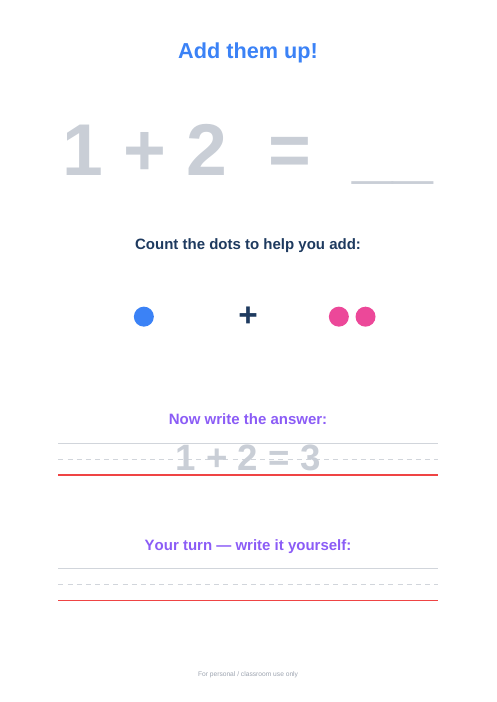
Our full addition guide walks through the whole journey from concrete objects to written number sentences; this guide is the deep dive on the facts underneath it all. For print-and-go practice — every addition fact to 10 with counting dots and traceable equations — the Simple Addition pack gives you pages to revisit whenever a bond needs reinforcing.
Practise this at home
Simple Addition to 10
12-page printable pack · £4.99 · Buy once. Yours forever. No subscription, no renewals.
Get the packParents also read
Number Formation 1-20: EYFS Guide
Number formation the UK-school way: the 0-9 rhymes teachers use, pencil grip stages by age, why reversals are normal, and how 11-20 build on 0-9.
Simple Addition for Ages 4–6
How to teach simple addition to 4–6 year olds the way UK schools do: concrete objects, then pictures, then written sums — with practical examples.
Shapes & Colours: What Reception Expects
What Reception actually expects your child to know about shapes and colours — 2D shapes, colour names and the honest truth about what's 'behind'.
Questions parents ask
What are all the number bonds to 5?
0+5, 1+4, 2+3, 3+2, 4+1 and 5+0. Each pair adds to five. The zero pairs (0+5 and 5+0) matter too — they teach that adding nothing leaves the number unchanged, which surprises more children than you'd expect.
Why not teach bonds to 10 straight away?
Because 10 is too big to see whole, and bonds learned by rote chanting don't stick. Bonds to 5 are learned as pictures — a hand, a five-frame — and become instant recall. Then bonds to 10 are just 'two fives' plus what they already know. Skipping 5 is the slow route disguised as the fast one.
My child can work out 2+3 but doesn't 'just know' it — is that a problem?
Not at all — working it out is the stage before knowing it. Instant recall grows out of dozens of successful workings-out, not from being drilled. Keep playing the games; one day the answer will arrive before the counting does, and you'll both notice.
Should they be writing number sentences yet?
Not necessarily. Bonds to 5 live happily in the world of objects, fingers and five-frames for a long time. Introduce '2 + 3 = 5' when they're curious about writing it — usually alongside early addition work. Writing too early turns a thinking game into handwriting practice.
How long does it take to learn the bonds to 5?
With a few minutes of games most days, children typically know the pairs within a few weeks and recall them instantly within a couple of months. There's no deadline — and a child who learns them slowly through play keeps them longer than one who memorises them under pressure.
What if my child finds it boring?
Then the game is wrong, not the child. Swap ping-pong for snack-splitting ('3 for you, 2 for me — that's 5!'), or make it physical with jumping and clapping. Bonds hide in everything; if one game bores them, the maths isn't the problem.