 LittleLearners
🔢 Early Maths
Place Value Year 2: Tens and Ones
The short answer
In Year 2, place value means knowing what each digit in a two-digit number is worth. In 34, the 3 stands for three tens (30) and the 4 stands for four ones (4). This guide covers England Year 2 only: two-digit numbers to 100. Hundreds come in Year 3.
What place value means — in one minute
Checked November 2026.
Take 34 and 43 — same two digits, different numbers. The 3 is worth 30 in the first and 3 in the second — where a digit sits decides what it is worth. That is the whole idea: a digit's position gives it its value.
Children say "ones", not "units". "Three tens and four ones" for 34 means they have got it; "three and four" means they are reading the digits, not the number.
Try it with one digit: put 8 in the ones column and it is worth 8. Move the same digit one column left and it is worth 80. One digit, moved across the table, changes value — the whole idea in five seconds.
Tens and ones: the one idea to get right
Everything in Year 2 place value hangs on one fact: ten ones make one ten.
Build it with your child. Put ten dried pasta pieces in a pile and call it one ten, then do it again: two piles and seven loose pieces is 27 — two tens and seven ones. Ten 1p coins are one 10p coin. Once a child has made tens with their hands, the numbers on the page make sense.
Schools draw this as a chart with two columns: T for tens, O for ones.
Read the chart left to right: tens first, then ones.
And the grouping rule, in a child's own language: you can't have more than 9 ones. When the ones reach 10, group them and move them into the tens column. Ask as you go: "What about 10? Where does that belong?"
- 27 sits as 2 tens and 7 ones.
- 40 sits as 4 tens and 0 ones.
- 9 sits as 0 tens and 9 ones.
What your child learns in Year 2
In England, the National Curriculum sets six things for Year 2 place value — here they are in plain words:
By the end of Year 2, your child should know the number bonds to 20 and be precise about place value. If bonds to 20 are still shaky, work on those first: place value rests on them.
- Counting in 2s, 3s and 5s from 0, and in 10s from any number, forwards and backwards.
- Knowing what each digit in a two-digit number is worth — tens and ones.
- Showing numbers in different ways, including on a number line.
- Comparing and ordering numbers from 0 to 100, using the signs <, > and =.
- Reading and writing numbers to 100, in numbers and in words.
- Using place value and number facts to solve problems.
Partitioning — splitting numbers more than one way
Partitioning means splitting a number into parts — and it helps to draw the split as a part-whole model: the whole number on top, the parts below. Every Year 2 child learns the first way: 23 is 20 and 3. The part most parents miss is the second way — 23 is also 10 and 13.
Why does that matter? Subtraction. Take 23 − 7. You cannot take 7 ones from 3 ones, so split it differently: 23 becomes 10 and 13, then 13 − 7 is 6, and 10 + 6 is 16. A child who can split numbers two ways gets there without counting on fingers.
Try it with 36: 30 + 6, then 20 + 16, then 10 + 26 — same number, three splits. If your child can do that, they understand what the digits are doing.
Zero the placeholder
Zero causes more confusion than any other digit in Year 2. In 30, the 0 means "no ones". Three tens, zero ones. It does not mean "nothing".
The mix-up shows up when a child writes 3 for thirty, or reads 40 as 4. Put them side by side: 3 is three ones, 30 is three tens. The 0 holds the ones place so the 3 stays in the tens.
Quick check: ask "how many ones in 70?" The answer is none — seven tens, zero ones. If your child answers 7, the zero has not clicked yet, and a few rounds with the chart above will fix it.
Ask them the question that makes them say it: "Where is the zero? Why do I put zero and not another number?" If they can answer "because there are no ones", the placeholder has clicked.
Comparing and ordering numbers to 100
The rule is short: tens first, then ones.
Take 47 and 29. The 4 in 47 means four tens; the 2 in 29 means two tens. Four tens beats two tens, so 47 is bigger — even though 9 is bigger than 7. Children who look at the ones first get this wrong every time. Tens decide; ones only matter when the tens match. 47 and 42? Same tens, so the ones decide: 7 beats 2, and 47 wins.
Ordering a set works the same way: smallest to largest for 18, 81, 38 and 83 is 18, 38, 81, 83. Check the tens first — 1, 3, 8, 8 — then sort the 8s by their ones: 81 before 83.
Play it as a game: write the digits 0–9 on cards and turn them face down. Each player picks two cards, arranges them to make the biggest number they can, reads it out, writes it down, and compares — who has the largest? Then switch it round and make the smallest number. The decision that matters is the arrangement: put the bigger digit in the tens place.
One grown-up term for the rule: the most significant digit. When comparing two numbers, look first at the digit with the largest value — for two-digit numbers, that is the tens digit.
Reading and writing numbers to 100
Year 2 children read and write numbers to 100 in numerals and in words. The trap is the teens. Thirteen and thirty sound close and look close, but they are 13 and 30 — a whole ten apart. Same for fourteen and forty, fifteen and fifty.
Say the pair out loud together, slowly: "thir-TEEN, THIR-ty." Teen numbers stress the end; tens stress the start. Once a child hears the difference, the spelling follows.
Try it as dictation: call out a number, your child writes it — thirteen, thirty, fourteen, forty. Five minutes, and you will know in one round whether the teen trap is still catching them.
Counting in 2s, 3s, 5s and 10s
Counting in steps is part of place value, not a separate topic. The steps in Year 2 are 2s, 3s and 5s from 0, and 10s from any number, forwards and backwards.
The 3s are new this year: Year 1 covered 2s, 5s and 10s, and Year 2 adds 3s. It is the one children trip on — 3, 6, 9, 12, 15 is not a pattern they know by heart yet.
The 10s catch children out differently. Counting 10, 20, 30 is easy; counting 12, 22, 32 is the real test, because the ones stay put while the tens climb. Backwards too: 52, 42, 32. If your child can count in 10s from 17 — 17, 27, 37 — the tens have clicked.
How to help at home in 5 minutes a day
Five minutes every day beats half an hour once a week. Here is the routine:
That is it — no app, no subscription, no special equipment. A handful of pasta, some coins and a pack of cards.
- Minute 1 — count in steps. Pick a step (2s, 3s, 5s or 10s) and count together, forwards then backwards. Change the starting number for the 10s.
- Minutes 2–3 — build a number. Call out a number up to 100 and your child makes it from things in the house: pasta bundled in tens with elastic bands, coins in piles of ten, buttons in groups of ten. Then they write it in the T | O chart.
- Minutes 4–5 — the bigger-number game. Deal two cards each from a pack of playing cards (face cards out) and make a two-digit number. Whoever has the bigger number keeps the cards — tens decide, as above.
Signs your child is finding it hard
Five things to watch for.
Digit reversal: 24 written as 42, or 17 as 71. The child knows the digits; they have not yet fixed which one is the tens. A week of daily practice with the chart above usually sorts it out.
Teen confusion: "seventeen" read as "seventy". Same trap as above — the words sound alike. Slow the pair down and say them together.
Counting in 10s from any number: 12, 22, 32 stalls after the first step, or the ones digit starts wandering — the tens are not solid yet.
Zero: 30 read as 3, or "how many ones?" answered with a shrug. The placeholder idea above needs another round.
None of these is a cause for worry on its own — they are normal mistakes for a Year 2 child learning a new idea. If two or three are still there after a few weeks of short practice, mention it to the teacher; they see it every year and will know which bit to work on.
Reading without understanding: your child reads 54 and 45 correctly and even knows which is bigger, but cannot say why. 54 is bigger because it has five groups of 10 and four ones, against four groups of 10 and five ones. If they can read the numbers but cannot explain the difference, place value has not clicked yet.
Practise this at home
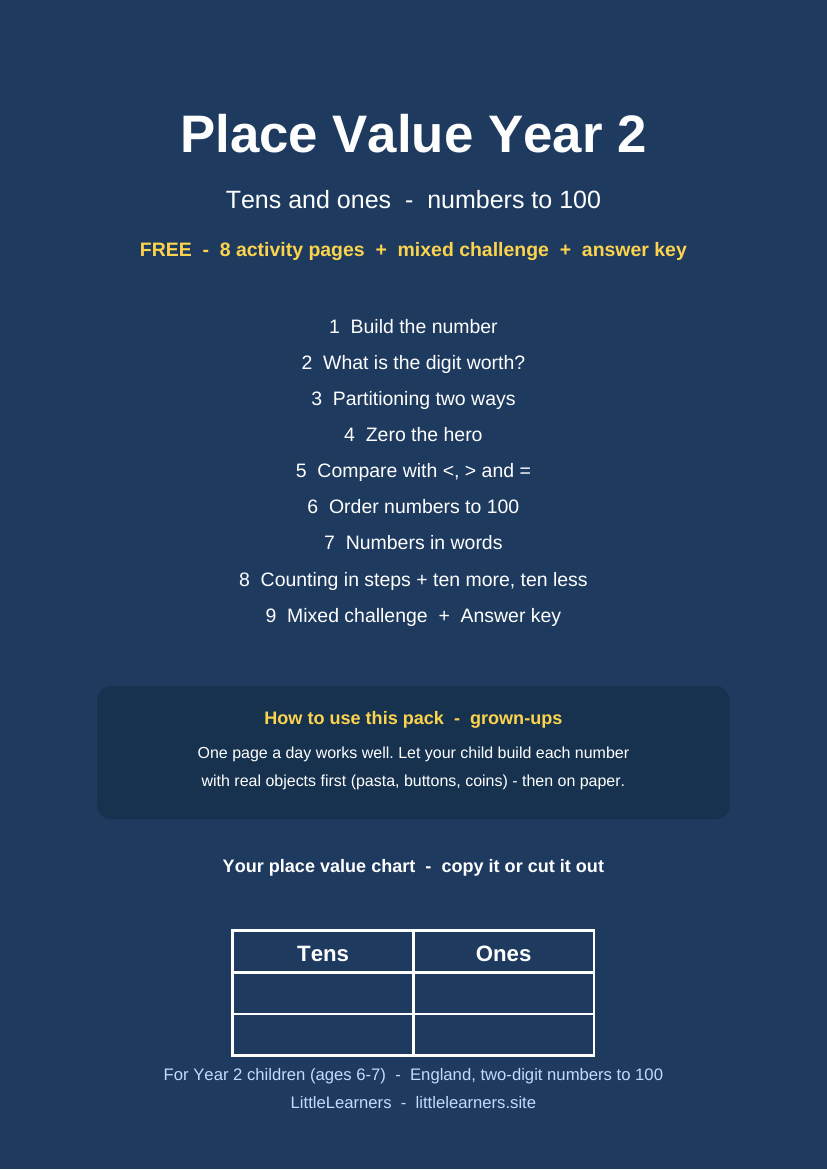
Place Value Year 2 Pack
10-page printable pack · FREE · Free forever. Download, print, enjoy — no sign-up, no payment.
Get the packParents also read
Number Formation 1-20: EYFS Guide
Number formation the UK-school way: the 0-9 rhymes teachers use, pencil grip stages by age, why reversals are normal, and how 11-20 build on 0-9.
Simple Addition for Ages 4–6
How to teach simple addition to 4–6 year olds the way UK schools do: concrete objects, then pictures, then written sums — with practical examples.
Shapes & Colours: What Reception Expects
What Reception actually expects your child to know about shapes and colours — 2D shapes, colour names and the honest truth about what's 'behind'.
Counting to 10: Fun Activities That Work
How to teach counting to 10: one-to-one correspondence, cardinality and subitising explained simply, plus counting games that work at home.
Number Bonds to 5 (and Why They Matter)
Number bonds to 5 explained for parents: what they are, why 5 comes before 10, five-frame activities and games that make the pairs stick.
Telling the Time: O'Clock (Ages 4–6)
O'clock means the minute hand points straight up at 12. UK children learn o'clock and half past in Year 1 — here is the order schools teach it.
Free printable packs for this topic
Questions parents ask
What is place value in simple words?
Place value is the rule that where a digit sits in a number decides what it is worth. In 34, the 3 is worth 30 because it sits in the tens place, and the 4 is worth 4 in the ones place. Same digits in a different order make a different number — that is why 34 and 43 differ.
What should my child know about place value by the end of Year 2?
By the end of Year 2, your child should know the number bonds to 20 and be precise about two-digit place value: tens and ones, partitioning, comparing and ordering to 100, and reading and writing numbers to 100 in words and numerals. That is the bar the National Curriculum sets. If number bonds are still wobbly, work on those first — our number bonds guide covers them step by step.
Why does my child write 17 as 71?
They know both digits — they have just not fixed which one is the tens yet. In 17, the 1 is one ten and the 7 is seven ones; in 71 it is the other way round. A week of building numbers in a chart, saying each digit's value out loud, usually fixes it.
Is 100 in Year 2?
Yes — children read, write, compare and order numbers to 100 in Year 2. But 100 is the top of the range, not the start of a new place: hundreds come in Year 3. So Year 2 work stays with two-digit numbers — 100 is the biggest number they meet.
What is the difference between tens and ones?
A ten is a group of ten ones. In 56, the 5 means five groups of ten (50) and the 6 means six ones (6). Children in Year 2 say "ones", not "units" — "five tens and six ones" is right.
How can I help my child with place value in 5 minutes a day?
Use the five-minute routine in this guide: one minute counting in steps, two building a number, two playing the bigger-number game. For ready-made practice, download our free place value pack — ten pages, two-digit numbers to 100, answer key included. Free, no sign-up.