 LittleLearners
🎨 Play-Based Learning
Benefits of Colouring for Children
The short answer
Colouring builds hand strength for writing, practises focus, teaches colour vocabulary and gives children creative control with no wrong answers. It is also a genuine calm-down activity. Its honest limit: it does not teach letter formation — that needs specific tracing practice. Ten to twenty minutes a day is plenty.
It builds the hand strength writing needs
This is the big one. Gripping a crayon and controlling it across a page works the small muscles of the hand and fingers — the same muscles that will later hold a pencil for writing. Every colouring session is quiet strength training.
It also builds the tripod grip (thumb and two fingers) naturally, especially with short, chunky crayons that cannot be grabbed in a fist. Teachers call this pre-writing work, and it genuinely makes letter formation easier when that stage arrives.
You will see the grip evolve if you watch over months: first the whole fist, then fingers pointing down the crayon, then the mature tripod hold. Each stage is normal — the crayon itself teaches the hand, which is why short crayons beat long ones. A stubby crayon simply cannot be held any way except with fingertips.
Focus, one crayon at a time
A colouring page gives a young child something rare: a task with a visible finish line. Choosing colours, staying roughly inside an area, deciding what comes next — all of it practises sustained attention in a way that open-ended play sometimes does not.
Ten focused minutes with crayons is ten minutes of concentration practice. For a 4-year-old, that is a meaningful workout, and it transfers to puzzles, books and classroom listening.
Finishing matters too. A colouring page is one of the first tasks a child can complete entirely on their own, and that experience of sticking with something until it is done builds persistence. Praise the finishing, not just the result: 'You kept going until every part was coloured — that's real sticking power.'
Colour names and colour sense
Colouring is where most children lock in their colour vocabulary — not just red and blue, but turquoise, peach, and 'dark green versus light green'. Naming colours as they pick them up turns a quiet activity into a language activity.
It also teaches early observation: grass is green but the sky is blue — and a purple sun is allowed too. Both lessons matter.
Creativity with no wrong answers
A colouring page is a gentle kind of creativity: structured enough not to be intimidating, open enough for real choices. Which colours? Patterns or solid fills? A blue dog? Every decision is theirs.
There is no wrong answer, which makes colouring one of the first activities where a child experiences genuine creative control — and the pride of finishing something that is entirely their own work.
The calm-down effect
Ask any parent: crayons are a reset button. The repetitive motion, the quiet focus, the absence of decisions that matter — it settles busy minds. Many families use colouring as the bridge between energetic play and calmer activities like dinner or bedtime stories.
It works for grown-ups too, which is why colouring together can become a genuinely peaceful shared ritual rather than just an activity you supervise from the sofa.
Many parents build it into the daily rhythm deliberately: twenty minutes of colouring after nursery while dinner cooks, or one page together before bed instead of a second story. Because it is screen-free and self-paced, it does not wire them up the way a cartoon before bed can. If the afternoons in your house tend to fray at the edges, try putting the crayon tin where the chaos usually starts.
Sneaky early maths
Colouring pages quietly smuggle in maths: counting how many stars need colouring, making AB patterns (red, blue, red, blue), noticing the symmetry in a butterfly's wings, comparing bigger and smaller areas.
You do not need to teach any of it formally. 'Can you colour every other stripe?' is a pattern lesson wearing a crayon costume.
There is spatial thinking in there as well: planning which area to colour first, judging whether the blue will fit inside the whale, rotating the page to reach a corner. These are the same mental skills that later help with geometry, maps and even handwriting layout on a page.
The honest limit: colouring won't teach letter formation
Here is the honest bit. Colouring builds hand strength and control, but it does not teach a child how to form letters — that needs specific practice with starting points and stroke directions, the way schools teach it.
Think of colouring as the gym and letter formation as the sport. The gym makes the sport easier, but it does not replace practice. When your child is ready for letters, tracing pages with proper formation take over from there.
Making colouring time richer
A few small habits multiply what colouring gives back. Start with the setup: a low table or floor space they can reach alone, crayons in an open tin rather than a zipped case, and paper they are allowed to take freely. When children can start colouring without asking permission, they do it far more often — and frequency is where the benefits compound.
- Narrate the colours: 'You've chosen emerald green for the leaves — great choice.' Vocabulary grows in these throwaway moments.
- Play stay-in-the-lines games — not as a rule, but as a challenge: 'Can you keep the blue inside the whale?' Control follows motivation.
- Colour together, side by side. Children absorb grip, patience and care from watching you.
- Display the finished work. A fridge gallery tells them their effort matters.
- If you'd like fresh pages to colour — friendly pictures sized for little hands, ready to print as often as you like — our mini colouring pack has them.
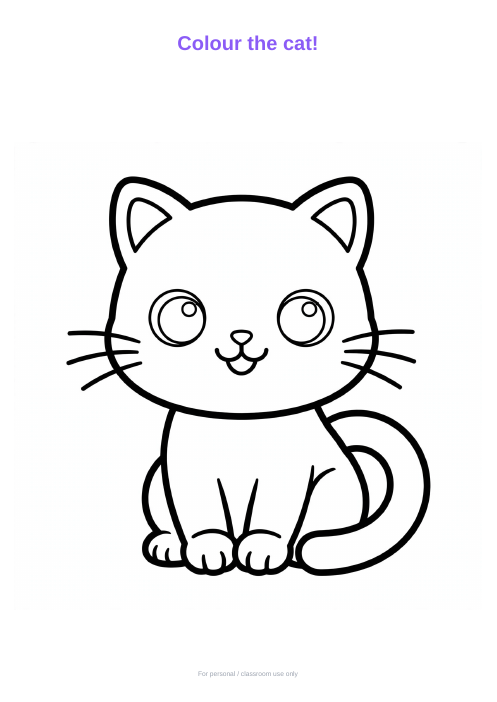
Practise this at home
Mini Colouring Pack
7-page printable pack · £2.99 · Buy once. Yours forever. No subscription, no renewals.
Get the packParents also read
Phase 2 Phonics Sounds in Order
Phase 2 sounds in teaching order — all five sets with pure-sound pronunciation tips, first blending words and a 5-minute daily routine.
What Is Phonics Phase 2? (UK)
Phase 2 phonics explained for UK parents: what children learn in Reception, when it's taught, the full phase timeline and 5 things to do at home.
Number Formation 1-20: EYFS Guide
Number formation the UK-school way: the 0-9 rhymes teachers use, pencil grip stages by age, why reversals are normal, and how 11-20 build on 0-9.
Questions parents ask
At what age can my child start colouring?
Most children start scribbling around 18 months and colour with some purpose between 3 and 4. Offer chunky crayons early; precision arrives on its own schedule and cannot be rushed.
Does it matter if they stay inside the lines?
Not at first. Scribbling is a developmental stage, not a mistake. Line control typically firms up between 4 and 5 — before that, enthusiasm matters more than accuracy.
Crayons, felt tips or colouring pencils — which is best?
Chunky crayons first: they build the tripod grip and do not snap under pressure. Felt tips are satisfying but bleed through paper; pencils need more pressure than little hands enjoy. Offer all three eventually and let preference lead.
How long should a colouring session last?
Follow the child. Ten to twenty minutes is typical at 4; some children will happily go longer. Stop while it is still enjoyable — a child who chooses to come back tomorrow is learning more than one who is made to finish.
Is colouring actually learning, or just keeping them busy?
Both, and that is fine. The fine-motor work, focus practice and colour vocabulary are real developmental gains — and peacefully keeping them busy is a legitimate parenting win too.
My child colours everything one colour — should I worry?
Not at all. A 'blue period' is normal and often just efficiency: one crayon, no decisions. Offer new colours casually — 'want to try the orange for the sun?' — without turning it into a lesson.