 LittleLearners
🎒 School Readiness
Screen-Free Learning Routine for Ages 3–6
The short answer
A screen-free routine for 3–6 year olds works best in short daily pockets: 10–15 minutes of printable practice, reading together, and learning woven into play and chores. The sample week below mixes phonics, maths, writing and motor skills across five days — about an hour a week of sit-down learning in total, with play doing the rest.
Why 'screen-free' doesn't mean 'lesson-heavy'
Let's be honest first: at 3–6, play IS the curriculum. Building towers teaches physics, arguing over rules teaches negotiation, and drawing all over everything teaches fine motor control. A screen-free routine isn't about replacing tablets with worksheets — it's about making sure the day has rich, hands-on things in it.
Also: no guilt. Screens exist, family life is busy, and an episode of something while you cook dinner has never ruined a child. This guide is for parents who want a screen-free learning rhythm in the day — not a moral position on technology.
The building blocks of the week
Across a week, aim to touch each of these — briefly, playfully, without ceremony:
- Phonics: 10 minutes daily of the routine in our phonics-at-home guide — revisit, blend, write, read
- Maths: counting in real life plus one focused activity (number formation, simple addition, shapes)
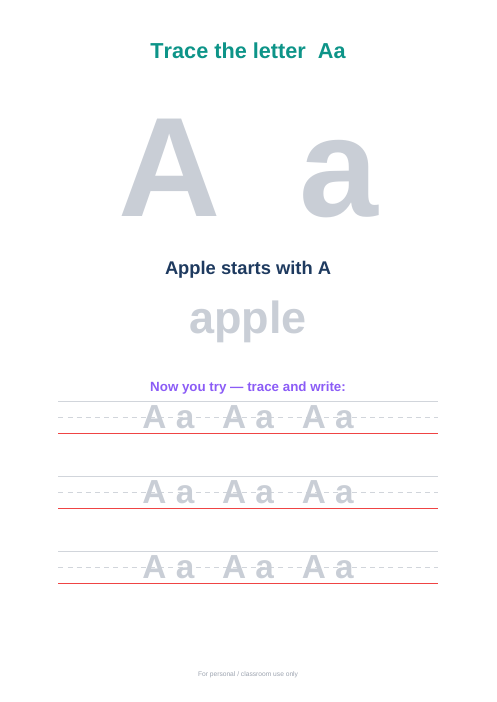
- Writing and fine motor: pre-writing strokes, tracing, cutting, threading, playdough
- Reading aloud: 10–15 minutes daily — the highest-value learning time there is
- Free play: the largest block by far, and doing more teaching than everything else combined
A sample week: ages 3–4 (20–30 minutes a day)
At this age, keep sit-down learning to one short pocket a day — everything else is play with learning smuggled inside:
- Monday: pre-writing play — chalk shapes on the pavement, 10 minutes
- Tuesday: counting everywhere — stairs, snacks, socks; count together all day
- Wednesday: scissor snipping — playdough snakes and paper strips, 10 minutes
- Thursday: colour and shape hunt around the house, then colour one picture
- Friday: favourite activity repeated — repetition is how this age learns
- Every day: bedtime story, plus rhymes and songs (Phase 1 phonics in disguise)
A sample week: ages 4–6 (30–45 minutes a day)
Reception-age children can handle a little more structure — two short pockets rather than one long session:
- Monday: phonics routine (10 min) + number formation tracing (10 min)
- Tuesday: phonics routine (10 min) + simple addition with real objects (10 min)
- Wednesday: phonics routine (10 min) + scissor skills lines and shapes (10 min)
- Thursday: phonics routine (10 min) + tricky word games (10 min)
- Friday: child chooses — revisit the week's favourite, then free choice
- Every day: reading aloud together, 10–15 minutes
Reading aloud: the highest-value 15 minutes
If you do nothing else in this guide, do this. Reading aloud daily builds vocabulary, story structure, attention and — eventually — the desire to read independently. It's the most evidence-backed activity in early childhood, and it takes fifteen minutes.
Make it interactive as they grow: ask what might happen next, let them 'read' familiar pages from memory, connect stories to their life ('remember when we saw a duck like that?'). This back-and-forth — sometimes called dialogic reading — multiplies the benefit. And keep reading aloud long after they can read alone; listening comprehension runs years ahead of reading ability.
Struggling to fit it in? Reading aloud doesn't have to mean bedtime. Breakfast reading, bath-time stories, a chapter in the car — the slot matters less than the daily habit. And let them choose the book, even if it's the same one for the twentieth time. Repetition is how young children learn language patterns; your boredom is their brain building.
Learning hidden in everyday life
The routine above is the visible part. The invisible part — woven through the day — teaches just as much:
- Cooking: weighing, counting spoonfuls, halving (early fractions!), sequencing a recipe
- Shopping lists: your child 'writes' the list (marks, scribbles, copied letters) and ticks items off
- Walks: I-spy with pure sounds, counting red cars, spotting shapes in buildings
- Tidying: sorting toys by type, colour or size is early classification
- Bath time: pouring and filling teaches capacity; foam letters teach sounds
When the routine falls apart (it will)
Sick days, holidays, new siblings, bad weeks — the routine will break, regularly. Here's the honest framework: aim for the routine 80% of the time and let the rest go without guilt. A child who does the routine four days a week for a year learns enormously; a child whose parent burns out chasing perfection learns that learning is stressful.
On broken days, keep just one thread: the bedtime story. It takes fifteen minutes, it needs no preparation, and it holds the learning rhythm until normal life resumes.
And if your child resists a particular activity for weeks — not days, weeks — believe them. Swap it for something else in the same area. The goal is a child who likes learning, not a completed checklist.
Start where you are
You don't need to implement the whole week on Monday. Start with two things: the bedtime story (if it isn't happening already) and one ten-minute pocket that matches what your child enjoys most. Add a second pocket when the first feels easy. In a month, you'll have a routine — built gradually, which is exactly how habits that last are made.
If you'd like the printable pages for every pocket in the week — phonics, numbers, addition, tricky words, scissor skills, shapes and colouring in one download — the Ultimate Bundle covers the full routine in 100 pages you can print as often as you like. Buy once, use for years, with siblings too.
Practise this at home
Ultimate Early Learners Bundle
214-page printable pack · £19.99 · Buy once. Yours forever. No subscription, no renewals.
Get the packParents also read
Reception Readiness Checklist UK
No test, no pass mark: the honest Reception readiness checklist — the 2025 Starting Reception definition, school-age facts and the first six weeks.
Halloween Activities for Preschoolers
12 Halloween activities for ages 3–5: low-mess crafts, learning games disguised as fun, no-carve pumpkins and a safety-first trick-or-treat plan.
Nursery Rhymes for Language
Why nursery rhymes are one of the strongest foundations for reading — rhythm, rhyme awareness and vocabulary — and how to get the most out of rhyme time at home.
Questions parents ask
How much 'learning time' does a 4-year-old need each day?
Less than most parents fear: 20–45 minutes of focused activity plus reading aloud, with the rest of the day in play. Play at this age is genuinely educational — it's not the break from learning, it's the main event.
Is some screen time actually harmful?
The honest answer: no credible evidence says a moderate amount of quality screen time harms young children. What matters is what it displaces — if screens replace sleep, play, reading and conversation, that's the problem, not the screen itself. Balance, not banishment.
What if we miss days — or weeks?
The routine bends; it doesn't break. Four days a week sustained over months beats a perfect fortnight followed by burnout. On chaotic days, keep just the bedtime story and restart tomorrow without guilt.
Should weekends be learning-free?
Mostly, yes — weekends are for family, rest and free play. If your child asks for their tracing or cutting pages (many do once it's habit), that's play, not school — let them. Reading aloud together is always welcome.
Can I use this routine alongside nursery or school?
Yes — keep home learning light when school is in session. Ten minutes of phonics practise plus reading aloud is plenty on school days; save the longer pockets for weekends and holidays. If school sends homework, that replaces the equivalent pocket rather than adding to it.
Do I need to buy lots of materials?
No. Printable pages, household items (pasta for counting, pegs for fine motor), library books and the great outdoors cover everything in this guide. One set of printables reused across siblings costs less than a single term of most activity subscriptions.