 LittleLearners
🎒 School Readiness
Christmas Activities for Kids Ages 3–6
The short answer
Christmas activities for kids aged 3–6 mix crafts, maths and quiet play: decorate a tree, count the presents to 10, trace Christmas words, solve a reindeer maze and write a letter to Santa. Each builds a skill — fine motor control, counting or letter formation — and every one is free to print.
Why Christmas is secretly brilliant for learning
December does the teaching for you. A child who will not sit still for a worksheet will happily count presents, trace the word "Santa" and argue about which bauble goes where — and all three are real learning hiding inside the excitement.
These Christmas activities for kids are built for ages 3–6, at home, with things you already own. Behind the scenes they touch all seven of the early years areas — talking and listening, moving and making, managing feelings, reading and writing readiness, early maths, finding out about the world, and making and imagining. You don't need to remember any of that. The skill line under each activity does the translating: what it is, what you need, how long it takes, and what it builds.
Checked December 2026.
Christmas crafts for little hands
Christmas crafts for preschoolers work best when the child does the making and you do the handing-over.
Safety first: child-safe scissors only, and stay at the table while they're out. Googly eyes and pom-poms are small parts — keep them away from under-3s and count them back in at the end.
If you search for Christmas crafts for EYFS you'll find nursery planning documents. These are the home versions of the same ideas — same skills, no planning paperwork, and nothing to buy.
- Decorate the tree: draw a big triangle tree, or print the pack's tree page, and let them cover it — crayons, stickers, torn paper. Fifteen minutes, low mess. Colour naming and pencil control.
- Bauble colouring: the pack's bauble page has the colour names written on it, so a child who can't read the word yet can still match it. Ten minutes, no mess. Colour naming and pencil control.
- Snowflake cutting: fold a square of paper in half, then in half again, and snip small triangles out of the folded edges. Open it up — a snowflake, every time. Fifteen minutes, medium mess, on a covered table. Scissor skills and hand control.
- Handprint reindeer: paint the hand brown and press it on card — the fingers are the antlers, the thumb is the muzzle. Add a red pom-pom nose and a googly eye. Fifteen minutes, medium mess. Finger control (holding the fingers spread as antlers) and colour naming.
- Decorate the stocking: the pack's stocking page is a blank stocking waiting for stripes, spots and a name across the top. Ten minutes, low mess. Creativity and colour naming.
- Christmas card: fold a card, draw on the front, write a name inside. Twenty minutes, glue-stick levels of mess. Fine motor control and early writing.
Christmas counting and thinking games
Counting hides inside Christmas better than in any workbook. Four games, all from the free pack, all playable at the kitchen table. Sit down, start counting, and correct gently when a number gets skipped — "let's count that one again" beats "that's wrong" every time.
- Count the presents to 10: touch each present as you count it — one touch, one number. That matching is one-to-one correspondence, the skill underneath all later counting. The counting guide has more games in the same style.
- Christmas I-spy: how many reindeer, baubles and stockings can you spot in the busy picture? Visual discrimination plus festive vocabulary — reindeer, bauble, stocking, snowflake.
- Reindeer maze: follow the path without lifting the pencil. Problem solving with a Christmas payoff at the end — and genuinely tricky enough for a 6-year-old.
- Spot the difference: two nearly identical pictures, five differences to find. Observation and attention to detail. Don't help too fast; let them stare.
Christmas words and writing
Writing sneaks in through the fun door at Christmas.
- Word tracing: Santa, star, gift — three words on UK handwriting lines in the pack. Trace, then try one freehand underneath. Letter formation, one word at a time. If your child is still forming numbers too, the number formation guide covers the 0–9 rhymes teachers use.
- A letter to Santa: the pack's guided letter gives the shape — greeting, one wish, a drawing, a sign-off. Let your child dictate the words and write what they can; you fill the gaps. Speaking and listening first, writing second. The letter formation hub has the four letter families if the writing itself needs work.
- Stories and carols: read a Christmas story, then ask your child to retell it in their own words. Sing a carol together and talk about any new words in it. Retelling builds the same comprehension schools look for later — no test, no worksheet.
Quiet-time Christmas
December is loud. Save two activities for when the noise tips over.
Snowflake colouring: slow, repetitive, no decisions — colour each point a different colour, or keep it to blues. Card colouring: colour the front of a card for someone, then write their name inside. Both are pencil control in disguise, and both buy you twenty quiet minutes.
If your child wants to colour in Christmas lights, draw a string of bulbs on plain paper and let them fill each bulb a different colour. No pack page needed — a pen and five minutes.
Colouring gets dismissed as time-filling. It isn't. The colouring guide makes the case for what it actually builds.
The free printable pack: what's inside
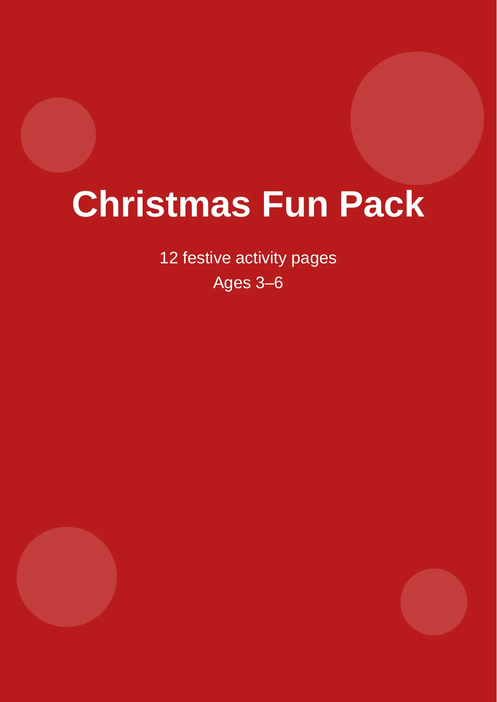
Twelve pages in one free PDF, no sign-up. Every page matches an activity above. The colouring pages are Christmas colouring pages for ages 3–6 — baubles with colour-name labels, snowflakes, and the stocking to decorate. Everything prints in black and white, and the colour names are labelled, so nothing depends on a colour printer. Download it free from the Christmas Fun Pack page — no sign-up, print as many times as you like.
- Christmas tree trace-and-decorate — the tree craft — pencil control, colour naming
- Bauble colouring — the bauble craft — colour naming, pencil control
- Count-the-presents to 10 — the counting game — counting to 10, one-to-one correspondence
- Christmas I-spy — the I-spy game — visual discrimination, festive vocabulary
- Reindeer maze — the maze game — problem solving, pencil control
- Spot-the-difference — the difference game — observation, attention to detail
- Word tracing (santa, star, gift) — the tracing activity — letter formation
- Decorate-the-stocking — the stocking craft — creativity, colour naming
- Snowflake colouring — quiet-time colouring — fine motor control, calm focus
- Guided letter to Santa — the Santa letter — early writing, speaking and listening
A one-activity-a-day Christmas week
One activity a day through the seven days before Christmas. Put the plan where your child can see it — ticking off each day is half the fun.
- Day 1: decorate-the-tree craft
- Day 2: count-the-presents game
- Day 3: word tracing and the letter to Santa
- Day 4: snowflake cutting (the messy-day activity — covered table, apron on)
- Day 5: reindeer maze and spot-the-difference
- Day 6: Christmas card making
- Day 7: quiet-time colouring and a Christmas story
When Christmas gets too much: calm corners
Christmas is exciting, and excitement tips into overload fast — late nights, sugar, visitors, routine out of the window. An overtired 4-year-old is not being difficult; they're done.
A calm corner is a spot, not a punishment: cushions, a blanket, the colouring pages, a book. When the noise gets too much, offer it as a choice, not a sentence. Ten minutes of quiet colouring resets most children.
Keep one thing the same each day — the same breakfast, the same bedtime story, the same morning walk. And if a day falls apart, drop the activity. The pack will still be there tomorrow; the child in front of you matters more than the plan.
What you need (and what you don't)
Paper, child-safe scissors, a glue stick, crayons or felt tips, cotton wool, a red pom-pom or two, googly eyes. That's the whole list.
What you don't need: anything bought specially. No craft kits, no glitter — leave the glitter in the cupboard; it buys ten minutes of sparkle and a month of hoovering.
Mess in one line: colouring, tracing and mazes — none. Cutting snowflakes and handprint reindeer — some, on a covered table. Card making — glue-stick levels only.
What if we don't celebrate Christmas?
Not every family celebrates Christmas, and this page doesn't assume yours does. The winter activities still work — snowflakes, counting, colouring, making cards for neighbours — and you can swap the Christmas words for winter ones wherever you like. If you do celebrate, the Nativity story is one more story to tell, not a lesson to teach.
Practise this at home
Christmas Fun Pack
12-page printable pack · FREE · Free forever. Download, print, enjoy — no sign-up, no payment.
Get the packParents also read
Reception Readiness Checklist UK
No test, no pass mark: the honest Reception readiness checklist — the 2025 Starting Reception definition, school-age facts and the first six weeks.
Screen-Free Learning Routine for Ages 3–6
A realistic screen-free learning routine for ages 3–6: a sample weekly plan built around printables, play and reading — no guilt, no marathon sessions.
Halloween Activities for Preschoolers
12 Halloween activities for ages 3–5: low-mess crafts, learning games disguised as fun, no-carve pumpkins and a safety-first trick-or-treat plan.
Nursery Rhymes for Language
Why nursery rhymes are one of the strongest foundations for reading — rhythm, rhyme awareness and vocabulary — and how to get the most out of rhyme time at home.
Bonfire Night Crafts for Ages 3–5
Bonfire Night with under-5s: toddler-simple history, the safety rules that matter (including sparklers), 6 easy crafts, and a survival plan for the night itself.
Phase 2 Phonics Sounds in Order
Phase 2 sounds in teaching order — all five sets with pure-sound pronunciation tips, first blending words and a 5-minute daily routine.
Free printable packs for this topic
Questions parents ask
What Christmas activities are best for 3-year-olds?
The simplest ones here: bauble colouring, count-the-presents and the reindeer maze — ten minutes each, no reading needed. Parents searching for Christmas activities for toddlers should know this page starts at 3 — under-3s need different materials and closer supervision.
Do Christmas crafts help with school readiness?
Yes, in the ordinary sense. Cutting builds scissor skills, tracing builds letter formation, counting presents builds counting to 10, and waiting for glue to dry builds patience. Those are the same skills Reception looks for — fine motor control, early maths, talking and listening — practised at the kitchen table. No craft makes a child "school-ready" on its own, and this page doesn't claim that.
How long should each activity take?
Ten to twenty minutes. If it takes longer, something's wrong — either the setup is too fiddly or the child has had enough. Short and regular beats long and rare, and stopping early is better than pushing through tears.
What if my child doesn't celebrate Christmas?
Use the winter versions: snowflakes, counting, colouring, cards for neighbours. Swap Christmas words for winter ones. Nothing on this page needs a Christmas tree in the house.
Is the printable pack really free?
Yes. Twelve pages, free PDF download, no sign-up, no email, no payment. Print it as many times as you like, at home or at a print shop.
What age is the Christmas Fun Pack for?
Ages 3 to 6. Three-year-olds manage the colouring, counting and tracing with an adult nearby; 5- and 6-year-olds can do the maze, the letter and spot-the-difference on their own. Under-3s should sit this one out — small parts and scissors.