🔢 Early Maths
Fractions Year 2: Halves, Quarters & Thirds
The short answer
In Year 2, a fraction is one or more equal parts of a whole. Cut a pizza into 4 equal slices and one slice is a quarter, 1/4; three slices are three quarters, 3/4. This guide covers England Year 2 only: halves, thirds and quarters — 1/2, 1/3, 1/4, 2/4 and 3/4 — nothing else.
What a fraction means — in one minute
Checked November 2026.
A fraction is a part of something whole — but only if the parts are equal. Cut a sandwich in half: the pieces must be the same size, or neither is a half. That is the one rule everything rests on: equal parts, or it is not a fraction.
Try it with a pizza or a bar of chocolate: split it into two, three or four parts — are they all the same size? If yes, you can talk about halves, thirds and quarters. If no, first make them equal.
Halves, quarters and thirds: the five fractions of Year 2
Year 2 has five fractions to learn — the only ones in the year, so learn each one properly.
Say them out loud together: half, third, quarter, two quarters, three quarters.
- 1/2 — one half: one of two equal parts.
- 1/3 — one third: one of three equal parts.
- 1/4 — one quarter: one of four equal parts.
- 2/4 — two quarters: two of four equal parts — the same as one half (section 6).
- 3/4 — three quarters: three of four equal parts.
What your child learns in Year 2
In England, the National Curriculum sets two things for Year 2 fractions — here they are in plain words:
Year 1 is the baseline: halves and quarters of objects, shapes and quantities. Year 2 adds thirds, three quarters, the 2/4 = 1/2 equivalence, and counting in fractions to 10 (section 7).
Year 3 is the boundary: tenths, adding and subtracting fractions and equivalent fractions come next year. Eighths or fifths on a worksheet are not Year 2 work in England — put them aside.
- Recognise, find, name and write 1/3, 1/4, 2/4 and 3/4 of a length, shape, set or quantity.
- Write simple fractions, for example 1/2 of 6 = 3, and recognise that 2/4 is the same as 1/2.
Fractions of shapes — shading
Most Year 2 fraction work starts with a shape — a circle, square or rectangle split into equal parts, some shaded. The shaded parts are the fraction; the rest is the whole.
Shade 1/3: split into 3 equal parts, shade 1. Shade 3/4: split into 4, shade 3. The parts you shade are the top number; the equal parts in the whole are the bottom.
The trap is unequal parts. A circle split into one big slice and two small ones is not thirds, however carefully your child shades one piece. Ask first: are the parts equal? If not, there is no fraction to shade.
Fractions of amounts — the sharing method
Fractions of amounts are the hardest part for parents to explain — and the most important, because it is really division in disguise. Share the amount into equal groups: one group is the unit fraction.
Take 1/3 of 12: share 12 counters into 3 equal groups — one group is the answer, 4. The examples below show the rest, including 1/2 of 6 = 3 from the curriculum itself.
Three quarters takes two steps: find one quarter first, then multiply by 3. 3/4 of 12: one quarter is 3, so three quarters is 3 × 3 = 9.
- 1/3 of 12 = 4 — 3 groups of 4.
- 1/4 of 12 = 3 — 4 groups of 3.
- 3/4 of 12 = 9 — 3 × 3.
- 1/2 of 6 = 3 — 2 groups of 3.
- 1/4 of 20 = 5 — 4 groups of 5.
- 1/3 of 9 = 3 — 3 groups of 3.
2/4 is the same as 1/2
This is the one equivalence in Year 2 — the same amount can have two names.
Fold a strip in half and shade one half. Fold the same strip into quarters and shade two quarters — the shaded part is the same length. Two quarters is the same as one half: 2/4 = 1/2.
On the number line it shows up the same way: count in quarters (1/4, 2/4, 3/4, 1) and in halves (1/2, 1) — 2/4 and 1/2 sit on the same spot. Two names, one number.
Children sometimes think 2/4 is bigger than 1/2 because 2 is bigger than 1. Show them the folded paper: the shaded piece has not changed size — the bottom number counts the cuts, the top number counts the pieces you have.
Counting in fractions
Fractions are numbers, not just pieces of pizza — and Year 2 children count in them: 1/4, 1/2, 3/4, 1, then 1 1/4, 1 1/2, 1 3/4, 2, and on up to 10.
Say it out loud together: one quarter, one half, three quarters, one, one and a quarter, one and a half, one and three quarters, two. The mixed numbers — 1 1/4, 1 1/2, 1 3/4 — are a whole number and a fraction together.
Counting stops fractions feeling like only shaded shapes. A child who can count 1 1/2 after 1 1/4 knows fractions sit on the same number line.
Numerator and denominator, in plain words
Two words appear on every fraction worksheet, and both are simpler than they sound: in 3/4, the top number is the numerator, the bottom number is the denominator, and the line between them is the fraction bar.
You do not need to drill these words — but when a worksheet uses them, your child should know which is which. Quick check: ask "what is the denominator of 3/4?" If they say 4, they have it.
- Denominator (bottom number): how many equal parts the whole was cut into — 4, in 3/4.
- Numerator (top number): how many of those parts you have — 3, in 3/4.
- Unit fraction: 1 on top — 1/2, 1/3, 1/4.
- Non-unit fraction: more than 1 on top — 2/4, 3/4. 3/4 is the first children meet.
How to help at home in 5 minutes a day
Five minutes every day beats half an hour once a week. Here is the routine:
That is it — no app, no subscription, no special equipment: a strip of paper, some counters and a pencil.
- Minute 1 — fold paper strips. Fold a strip in half, then into quarters. Shade one half, then two quarters — same amount, two names (2/4 = 1/2).
- Minutes 2–3 — share the counters. Put 12 counters out and ask for a third: share into 3 groups, count one group (4). Then a quarter: 4 groups, one group is 3. Then three quarters: 3 × 3 = 9.
- Minutes 4–5 — the shade-and-name game. Draw a circle split into 4, shade 3. Your child names it (3/4), then draws one for you. Swap roles.
Signs your child is finding it hard
Four things to watch for.
Unequal parts called halves: your child shades one piece of a circle split into one big slice and two small ones and calls it a half. Go back to the sandwich test in section 1.
Bigger bottom number, bigger fraction: your child says 1/4 is bigger than 1/2, because 4 is bigger than 2. Fold the paper strip: a quarter is smaller, because the whole was cut into more pieces.
Dividing by the top number: asked for 1/3 of 12, your child answers 3 — they divided by the 3 on top instead of sharing into 3 groups. Share 12 into 3 groups and count one — 4, not 3.
Shading 3/4 as three shapes out of four: your child shades three whole shapes from a set of four and calls it three quarters. Three quarters means three parts of one whole cut into four.
None of these is a cause for worry on its own — they are normal mistakes for a Year 2 child learning a new idea. If two or three are still there, mention it to the teacher.
Practise this at home
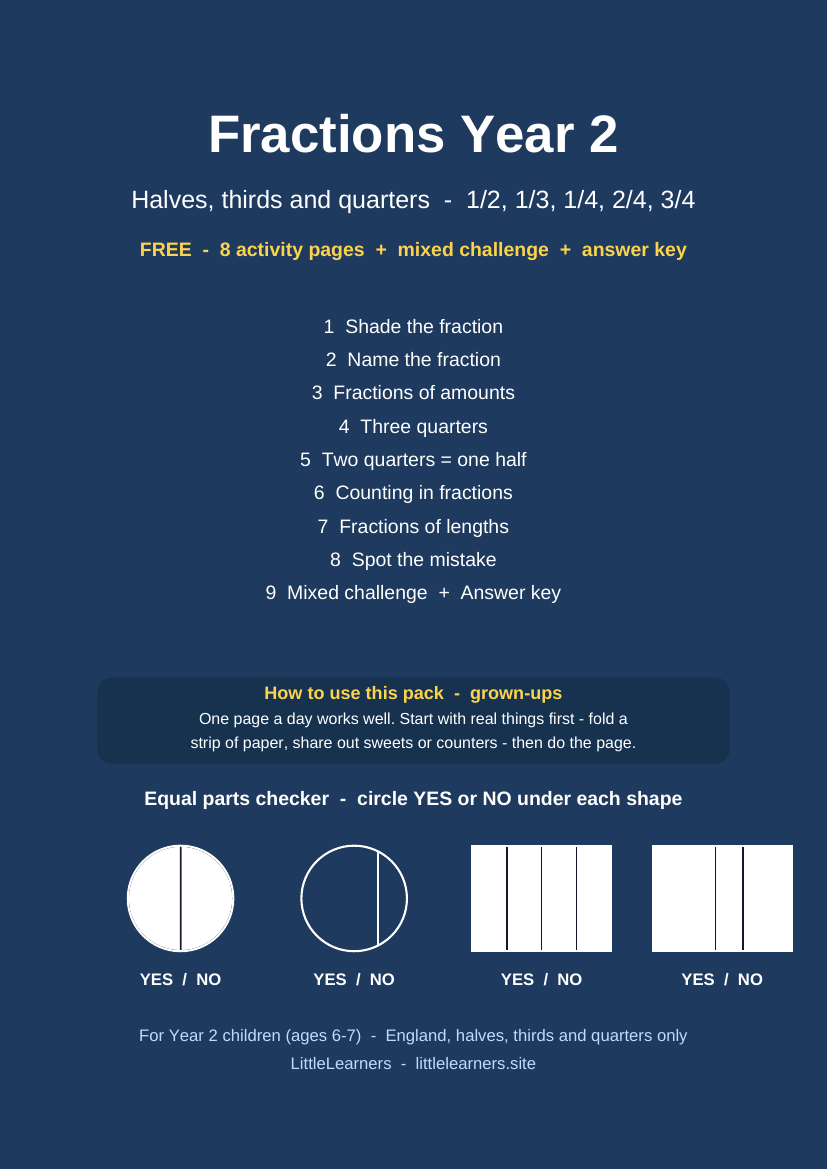
Fractions Year 2 Pack
10-page printable pack · FREE · Free forever. Download, print, enjoy — no sign-up, no payment.
Get the packParents also read
Number Formation 1-20: EYFS Guide
Number formation the UK-school way: the 0-9 rhymes teachers use, pencil grip stages by age, why reversals are normal, and how 11-20 build on 0-9.
Simple Addition for Ages 4–6
How to teach simple addition to 4–6 year olds the way UK schools do: concrete objects, then pictures, then written sums — with practical examples.
Shapes & Colours: What Reception Expects
What Reception actually expects your child to know about shapes and colours — 2D shapes, colour names and the honest truth about what's 'behind'.
Counting to 10: Fun Activities That Work
How to teach counting to 10: one-to-one correspondence, cardinality and subitising explained simply, plus counting games that work at home.
Number Bonds to 5 (and Why They Matter)
Number bonds to 5 explained for parents: what they are, why 5 comes before 10, five-frame activities and games that make the pairs stick.
Telling the Time: O'Clock (Ages 4–6)
O'clock means the minute hand points straight up at 12. UK children learn o'clock and half past in Year 1 — here is the order schools teach it.
Free printable packs for this topic
Questions parents ask
What is a fraction in simple words?
A fraction is one or more equal parts of a whole. Cut a pizza into 4 equal slices and one slice is a quarter, 1/4; cut it into 2 and one is a half, 1/2. The parts must be equal — if they are not, it is not a fraction.
What fractions does my child learn in Year 2?
In England, Year 2 covers five fractions: 1/2, 1/3, 1/4, 2/4 and 3/4. Your child learns to recognise, find, name and write them for shapes, lengths, sets and quantities, and to recognise that 2/4 is the same as 1/2 — halves and quarters carry over from Year 1; thirds and three quarters are new. For the rest of Year 2 maths, see our Year 2 maths hub.
What is 3/4?
Three quarters means three out of four equal parts of a whole. If a pizza is cut into 4 equal slices and you eat 3, you have eaten 3/4. It is the first non-unit fraction your child meets — more than one part on top.
Is 1/2 in Year 2?
Yes — halves are taught in Year 1 and used again in Year 2. Your child needs 1/2 to understand the year's one equivalence: 2/4 is the same as 1/2. Half of 6 is 3, which is the worked example the National Curriculum itself gives.
Are eighths in Year 2?
No — eighths, fifths and tenths come later, in Year 3 and beyond. Australian Year 2 includes eighths, so some websites teach them, but England Year 2 is 1/2, 1/3, 1/4, 2/4 and 3/4 only. A worksheet asking for eighths is not matched to the English curriculum — put it aside.
How can I help my child with fractions in 5 minutes a day?
Use the five-minute routine in this guide: one minute folding paper strips, two minutes sharing counters, two minutes playing the shade-and-name game. For ready-made practice, download our free fractions pack — ten pages, 1/2, 1/3, 1/4, 2/4 and 3/4 only, answer key included. Free, no sign-up.