 LittleLearners
✏️ Writing & Fine Motor Skills
Year 2 Grammar for Parents
The short answer
In Year 2, children learn six grammar building blocks: punctuation (full stops, commas and apostrophes), four sentence types, expanded noun phrases, keeping tenses consistent, joining clauses with words like because and but, and suffixes such as -ment and -ful. This guide explains each one in plain English, with examples and free printable practice.
What does Year 2 grammar actually cover?
Six blocks. That is the whole list, and everything in Year 2 grammar fits inside one of them. The list comes from English Appendix 2 of the National Curriculum — the official list of grammar terms for Year 2. If a worksheet or website teaches something outside these six blocks, it is either revision from Year 1 or work for a later year.
- Punctuation — full stops, capital letters, question marks, exclamation marks, commas in lists, and apostrophes
- Sentence types — statements, questions, exclamations and commands, and picking the right one
- Expanded noun phrases — small describing words that make a noun more precise
- Tenses — present and past, kept consistent, including the progressive form
- Joining clauses — subordination (when, if, that, because) and co-ordination (or, and, but)
- Suffixes — endings such as -ment, -ness, -ful, -less, -ly, -ed, -er and -est
Punctuation: the five marks that matter in Year 2
Read this sentence out loud: sam went to the park he bought apples bananas and grapes. It runs out of breath, because nothing tells you where one thought ends and the next begins. Punctuation does that job. Five marks carry almost all of Year 2.
- Full stop — ends a statement. "Milo hid under the kitchen table." If you can hear the sentence end, the full stop goes there.
- Capital letter — starts a sentence, and marks names of people and places, and the word I. "On Tuesday, Amira visited her gran in Leeds." Days and months take capitals too; seasons do not.
- Question mark — ends a question, and only a question. "Where did you put my red jumper?" A sentence starting with "I wonder" is not a question, so it takes a full stop.
- Exclamation mark — marks strong feeling: surprise, humour, excitement. "What a tall sunflower that is!" It is not a louder full stop; one per piece of writing is usually plenty.
- Comma — in Year 2, one job: separate items in a list. "For lunch we had soup, bread, cheese and grapes." No comma before "and" when only two things are listed.
- Apostrophe — two jobs. Contraction: letters are missing, so the apostrophe marks the gap ("I can't find my pencil"). Possession: something belongs to someone ("That is Zara's coat"). An apostrophe never makes a plural.
The four sentence types — and how to tell them apart
Four types. Children are expected to choose the right form for the purpose, not just recognise them.
- Statement — tells you something, ends with a full stop. "The library opens at nine o'clock."
- Question — asks something, ends with a question mark. "Did you feed the rabbit this morning?"
- Exclamation — shows strong feeling, starts with what or how, ends with an exclamation mark. "How fast that train goes!"
- Command — tells someone to do something, ends with a full stop or an exclamation mark. "Put your shoes by the door, please."
Expanded noun phrases: small words, better sentences
Here is the trick. Take a plain noun, add describing words in front of it, and the sentence gets better without getting complicated. The National Curriculum's own example is "the blue butterfly": "blue" expands "butterfly" by telling you which one. That is all an expanded noun phrase is — a noun with extra detail attached. Children are not asked to name the device. They are asked to use it, so their writing says more.
- a dog — a muddy dog with floppy ears
- the cake — the chocolate cake with pink icing
- a bird — a tiny bird with a yellow beak
Tenses: keeping past and present consistent
Tense is where Year 2 writing usually wobbles. The rules themselves are simple — the hard part is staying in the same tense through a whole piece of writing. Children start a story in the past tense and drift into the present halfway down the page.
- Present: "Lily walks to school."
- Past: "Lily walked to school yesterday."
- Present progressive (happening right now): "Lily is walking to school right now."
- Past progressive (was happening): "Lily was walking home when it started to rain."
Joining clauses: because, if, when, that / and, but, or
A clause is a group of words with a verb in it. Year 2 children learn to join clauses with two families of joining words, and the lists matter, so learn them exactly: subordinating — when, if, that, because; co-ordinating — or, and, but. One warning: some American sites list seven co-ordinating conjunctions (for, and, nor, but, or, yet, so). That list is not the Year 2 list in England. Stick to or, and, but.
The joining word changes the meaning, and children feel that faster than any definition. "Sara took an umbrella because rain was forecast" gives a reason; "Sara took an umbrella, but she still got wet" tells a different story. Try this pair out loud: "I'll help you when I finish this page" (it will happen) versus "I'll help you if I finish this page" (it might not). When your child uses "because" to answer a question, they are already doing subordination. Name it once, then leave it alone.
Suffixes: what happens when you stick letters on the end of a word?
A suffix is a group of letters added to the end of a word. It changes what the word does, and the root word underneath stays recognisable — "kind" is still in there when you write "kindness".
- Makes a noun: -ment, -ness, -er — enjoy to enjoyment, kind to kindness, teach to teacher
- Makes an adjective: -ful, -less — hope to hopeful, care to careful
- Compares, or turns an adjective into an adverb: -er, -est, -ly — tall to taller to tallest, quick to quickly
The mistakes Year 2 children actually make (and the 10-second fixes)
Most Year 2 grammar mistakes are the same five. Fix the pattern, not the sentence.
- Apostrophe on a plural — "The dog's are barking." Nobody owns anything, so drop it: "The dogs are barking."
- A comma before "and" in a two-item list — "I like apples, and pears." Two items need no comma. The comma appears at three items and up.
- Tense switching mid-story — "We went to the beach and build a castle." One tense per piece: read it back and listen for the switch.
- A "because" on its own — "Because it was raining." That is half a sentence. Join it: "We stayed inside because it was raining."
- An exclamation mark on everything — "I went to school!" Save the mark for real feeling. If it is not surprising, funny or exciting, it takes a full stop.
How to help at home in 10 minutes a day
Ten minutes. That is the whole plan. Four games, no preparation, nothing to buy. Do one game a day, not all four — regular and short beats long and rare.
- Punctuation spotter — open any bedtime book. Your child points to every capital letter and full stop on one page, then finds one question mark.
- Finish the sentence — you start, they finish, with a joining word. "The cat ran across the road when…" Each ending changes the story.
- Stretchy sentences — start small ("A frog sat on a log"), then stretch it with describing words, then again with a joining word.
- Suffix hunt — open any book and find three words ending in -ful or -less, and three ending in -ly. Ask what each word would mean without its ending.
Free Year 2 grammar worksheets
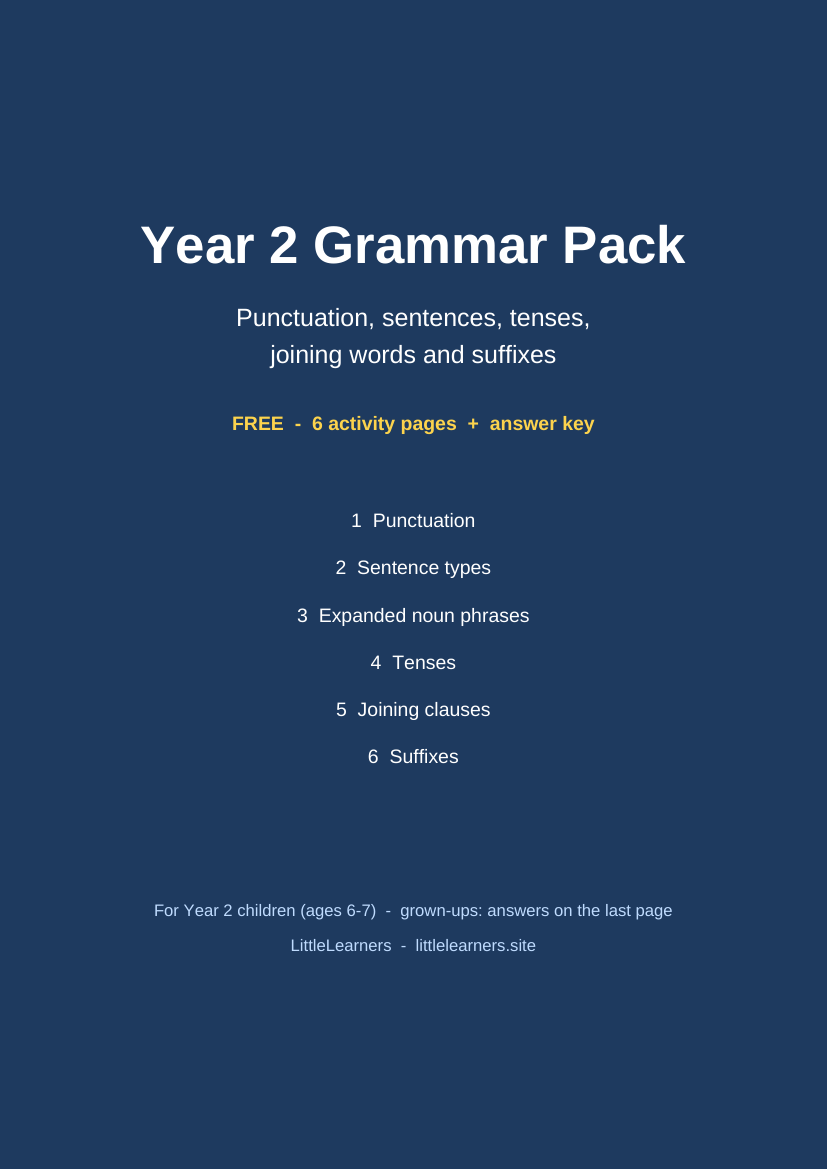
The free pack matches this guide page for page: six pages, one per block, three questions on each page, and an answer key at the back so you can check together without guessing. The pack is free, with no sign-up and no email needed.
Start with the block your child trips over most — usually punctuation or suffixes. Do one pack page, then one 10-minute game. That is enough for this week.
Practise this at home
Year 2 Grammar Pack
8-page printable pack · FREE · Free forever. Download, print, enjoy — no sign-up, no payment.
Get the packParents also read
Pre-Writing Skills Before Letters
Before letter tracing: the pre-writing strokes — lines, curves, zigzags and shapes — that build the hand control children need for writing.
Pencil Grip Guide for Parents: Ages 3–6
The tripod grip explained for parents: how pencil grip develops, what to model, practical exercises — and what not to correct too early.
Scissor Skills Progression (Ages 3–5)
The scissor skills progression: snipping, straight lines, zigzags, curves and shapes — with safety basics and left-handed tips for parents.
Line Tracing: The Full Progression
The line tracing progression, level by level: finger tracing to thin lines, mazes and shapes — when to move up, and how to know your child is ready.
Easy Mazes for Preschoolers
Why mazes are secretly brilliant for little hands — pencil control, concentration and problem-solving — plus when to start, how to progress, and the honest limits.
Colour by Number for 4 Year Olds
Why colour by number is more than colouring — number recognition, concentration and fine motor control — plus the right age to start and how to keep it fun.
Free printable packs for this topic
Questions parents ask
What is taught in Year 2 grammar?
Six blocks: punctuation, four sentence types, expanded noun phrases, tense consistency, joining clauses, and suffixes. This guide covers all six, in that order.
What is a suffix?
A group of letters added to the end of a word that changes what the word does — for example, -ful turns "hope" into "hopeful", and -ness turns "kind" into "kindness".
What is an expanded noun phrase?
A noun with extra describing words attached, such as "the blue butterfly" or "a muddy dog with floppy ears". It tells the reader which one, and what it is like.
What is a subordinate clause?
A clause — a group of words with a verb — that cannot stand on its own and needs a main clause beside it. In "We stayed inside because it was raining", "because it was raining" is the subordinate clause.
Is SPaG the same as grammar?
No. SPaG is the umbrella word for spelling, punctuation and grammar together. This page teaches the grammar part in depth. A separate SPaG guide is planned.
How is Year 2 grammar assessed?
Through your child's everyday writing. Teachers look for these skills in classwork and written work, not in a separate grammar exam. The quickest way to know how your child is doing is a word with their teacher.