 LittleLearners
✏️ Writing & Fine Motor Skills
Year 2 SPaG for Parents
The short answer
SPaG stands for spelling, punctuation and grammar: the three parts of English children learn in Year 2. Spelling covers patterns and tricky words; punctuation covers full stops, commas and apostrophes; grammar covers sentence types, tenses and joining clauses. This guide explains each part, what Year 2 covers, and whether there is a test.
What does SPaG stand for?
The word turns up everywhere and nobody explains it: on the homework sheet, at parents' evening, on a worksheet headed "SPaG" that neither of you can decode. That is normal. SPaG is school shorthand, and this page translates it — all of it, in plain English.
Three words. Spelling. Punctuation. Grammar. One umbrella word holds them because schools teach them together and test them together — but they are three different jobs, and mixing them up is half the confusion.
You may also see it called GPS — grammar, punctuation and spelling, the same three parts in a different order. Some schools use GPS for the subject and the test papers.
Why one word? A sentence needs all three at once: spelling puts the words down right, punctuation shows where thoughts start and stop, grammar builds the sentence so it says what it means.
The three strands at a glance
That is the whole map. If you remember nothing else, remember the three rows.
- Spelling — Getting words down in letters. Year 2 covers spelling patterns, tricky words and suffixes.
- Punctuation — The marks that shape sentences. Year 2 covers full stops, capitals, question and exclamation marks, commas and apostrophes.
- Grammar — Building sentences that say what they mean. Year 2 covers sentence types, describing words, tenses, joining clauses and suffixes.
Spelling in Year 2: patterns, tricky words, and phonics
Spelling in Year 2 runs on three rails.
First, phonics. Children use Reception and Year 1 sounds to build spellings: hear the sounds, match letters to them. Phonics does not stop when reading takes off — it becomes the way in to spelling.
Second, patterns. Year 2 teaches the spelling patterns — how words change when endings are added, and the rules that hold most of the time. The lists live on the spelling hub.
Third, the words that break the patterns. Common exception words — said, was, some, come — are learned as whole words, by sight and practice. Fixed sets exist for Year 1 and Year 2; the common exception words hub carries both.
Suffixes sit across both strands — an ending like -ful or -ness changes a word and its spelling. Spelling side: the spelling lists. Grammar side: the grammar page.
Punctuation in Year 2: the six marks that matter
Six marks, each with a single job in Year 2. The job is the whole lesson.
That is the complete Year 2 list; anything beyond these six belongs to a later year. The teaching — examples and the mistakes children make — sits on the grammar page.
- Full stop — Ends a statement. One thought, one full stop.
- Capital letter — Starts a sentence, and marks names of people and places, and the word I.
- Question mark — Ends a question, and only a question.
- Exclamation mark — Marks strong feeling — surprise, humour, excitement. Not a louder full stop.
- Comma — In Year 2, one job: separate items in a list.
- Apostrophe — Two jobs: letters are missing (can't, she'll), or something belongs to someone (Zara's coat). Never a plural.
Grammar in Year 2: the topics, in one paragraph each
Grammar trips parents up most, because its vocabulary sounds technical. It is not. Each topic in two lines; the teaching is one click away.
- Sentence types — Four forms: statement, question, exclamation, command — picked for the purpose, not just named.
- Describing words — Expanded noun phrases: a noun with extra detail attached. The National Curriculum's own example is "the blue butterfly" — "blue" tells you which butterfly.
- Tenses — Present and past, kept consistent, including the progressive "is walking / was walking" shape.
- Joining clauses — Two short, fixed lists: subordination (when, if, that, because), co-ordination (or, and, but). The word changes the meaning, so the lists are exact.
- Suffixes — Endings added to words — -ment, -ness, -ful, -less, -ly, -ed, -er, -est — that change what a word does.
- The terminology itself — Appendix 2 also names the words for talking about writing: noun, verb, adjective, clause, conjunction, tense — used when discussing writing, never recited.
The words schools use: a plain-English glossary
Keep this open during homework. One line each. No more explanation needed — that is the point.
- SPaG — Spelling, punctuation and grammar — the three strands together
- Appendix 1 — The spelling part of the National Curriculum
- Appendix 2 — The vocabulary, grammar and punctuation part of the National Curriculum
- Phoneme — A single sound in a word — "cat" has three: c-a-t
- Grapheme — The letter or letters that write a sound down
- Segmenting — Splitting a word into its sounds, to spell it
- Common exception word — Breaks the usual spelling pattern; learned as a whole word
- Homophone — Sounds the same as another word, but spelled differently with a different meaning — "to", "two", "too"
- Suffix — Letters added to the end of a word that change what it does
- Noun phrase — A noun with describing words attached — "the blue butterfly"
- Clause — A group of words with a verb in it
- Conjunction — A joining word, such as and, but or because
- Tense — The form of a verb that shows when something happens
- Progressive — The "is / was + -ing" form, showing something in progress
- Apostrophe — The mark that shows missing letters or belonging
- Determiner — A word before a noun that says which one — the, a, this, some
Is there a Year 2 SPaG test?
Short answer: there may be a test, but it is optional, and your child's school decides.
Since the 2023/24 school year, the end of Key Stage 1 tests have been non-statutory. The Standards and Testing Agency still produces optional papers, including an English grammar, punctuation and spelling paper, and schools can use them or not, as they see fit. Results are not reported to the government, and the tests play no part in judging a school. Teacher assessment goes on as before, judged from everyday classwork.
Schools that use the optional papers usually give them in May, in Year 2 — a recommendation, not a fixed date. The papers come in two short parts: a 20-word spelling test, read out by the teacher, and a grammar, punctuation and vocabulary paper in two short sections. Together they take around half an hour and are not strictly timed; schools run them flexibly, so the format varies.
One piece of history, stated carefully: the grammar, punctuation and spelling test began in May 2013 — for Year 6, not Year 2.
One confusion worth clearing up: the Phonics Screening Check is a different check entirely. It is a statutory Year 1 check, taken in June, in which a child reads 40 words aloud — half real, half made-up — one to one with a teacher. Children who do not meet the standard in Year 1 retake it in Year 2. It is not a SPaG test.
So what should you do? Nothing, unless your child's school says otherwise. If a letter mentions optional tests, ask the teacher: does the school use them, and what are the results for? Your child does not need test preparation for an optional Year 2 paper.
SPaG, grammar, phonics, literacy — what's the difference?
Four words, four jobs — and schools use all four in the same letter.
A sheet headed "SPaG" means one of the three strands, usually grammar or punctuation. "Phonics" means sounds and letters. "Literacy" means everything. One word each, and the letters home get easier to read.
- SPaG — The umbrella. It names the three strands together and says nothing on its own.
- Grammar — One strand under the umbrella: building sentences.
- Phonics — The route in: matching sounds to letters to read and spell, mostly in Reception and Year 1. It feeds spelling; it does not replace it.
- Literacy — English, the subject name schools use most — is the whole subject: reading, writing, speaking, listening. SPaG sits inside it.
How to help at home without teaching it wrong
The fear is real: help the wrong way and you contradict the teacher. Stay on the noticing side, not the teaching side.
Read together and point at punctuation: a question mark in a bedtime story, a capital letter starting a name. Ten seconds, then back to the story.
Use the school's words. If the school says "expanded noun phrase", use that phrase at home. Two names for one thing confuse children faster than any jargon.
Play short spelling games: call out a word, ask for its sounds, then its letters. Two minutes in the kitchen counts. Long sessions do not.
Ten minutes, low pressure. Short and regular beats long and rare. If your child resists, stop — the teacher covers the teaching; your job is keeping the words familiar.
Free practice: where to go next
This page explains. The practice lives on the pages that own each strand.
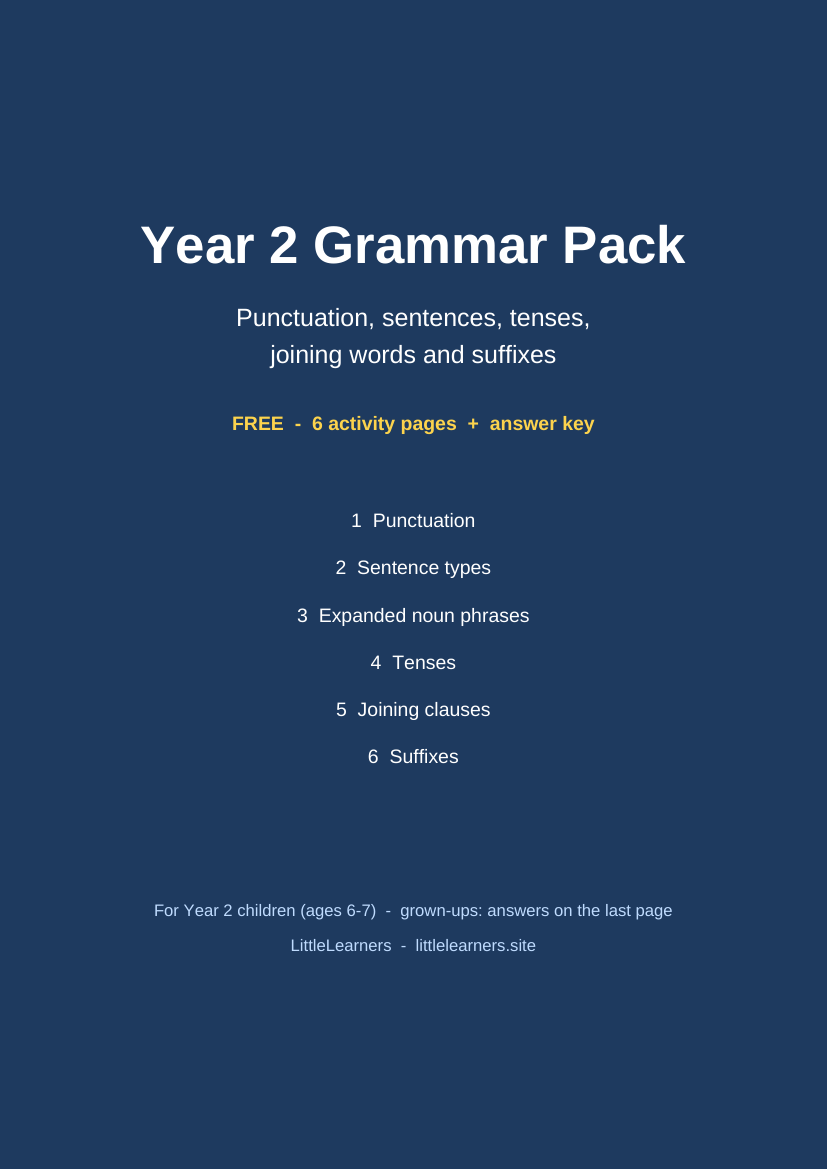
The Year 2 Grammar Pack: grammar and punctuation practice with an answer key. The KS1 spelling lists hub: patterns and word lists. The common exception words hub: the words that break the patterns. All free, no sign-up, no email.
Start with the strand your child trips over most: one page of practice, then one ten-minute game from the section above. That is enough for this week. Unknown term from the teacher? Come back to the glossary.
Practise this at home
Year 2 Grammar Pack
8-page printable pack · FREE · Free forever. Download, print, enjoy — no sign-up, no payment.
Get the packParents also read
Pre-Writing Skills Before Letters
Before letter tracing: the pre-writing strokes — lines, curves, zigzags and shapes — that build the hand control children need for writing.
Pencil Grip Guide for Parents: Ages 3–6
The tripod grip explained for parents: how pencil grip develops, what to model, practical exercises — and what not to correct too early.
Scissor Skills Progression (Ages 3–5)
The scissor skills progression: snipping, straight lines, zigzags, curves and shapes — with safety basics and left-handed tips for parents.
Line Tracing: The Full Progression
The line tracing progression, level by level: finger tracing to thin lines, mazes and shapes — when to move up, and how to know your child is ready.
Easy Mazes for Preschoolers
Why mazes are secretly brilliant for little hands — pencil control, concentration and problem-solving — plus when to start, how to progress, and the honest limits.
Colour by Number for 4 Year Olds
Why colour by number is more than colouring — number recognition, concentration and fine motor control — plus the right age to start and how to keep it fun.
Free printable packs for this topic
Questions parents ask
What does SPaG stand for?
Spelling, punctuation and grammar — the three strands of English taught together in Year 2.
Is SPaG the same as grammar?
No. Grammar is one of the three strands. SPaG is the umbrella word for all three together.
Is the Year 2 SPaG test compulsory?
No. End of Key Stage 1 tests have been optional since 2023/24. Schools choose whether to use them; results are not reported to the government. Check with your child's school.
What is the difference between SPaG and phonics?
Phonics matches sounds to letters for reading and spelling. SPaG covers spelling, punctuation and grammar. Phonics feeds spelling; the two are not the same thing.
Does my child need SPaG worksheets?
Not a separate SPaG set — the grammar pack and the spelling and exception-word hubs already cover all three strands, free.
What is an expanded noun phrase?
A noun with extra describing words attached, such as "the blue butterfly". It tells the reader which one, and what it is like.